
AI Summary
Have you ever walked by a corporate dining hall at 2 p.m.? Noticed those stacks of untouched pasta and wilted salads sitting there? Quite unpleasant and quite possibly a waste of up to $1200-$3000 per month (based on a typical waste rate of approximately 25%) for the average-sized office; and, when you factor in there are over 40,000 corporate dining applications in Canada, you start to see the national embarrassment associated with this scenario.
Food waste isn’t inevitable; it’s fixable. Nuu Catering has helped its 500+ partner offices reduce food waste by 32% through the implementation of smart systems. The ‘How to Reduce Food Waste’ guide outlines eight steps to reducing food waste—all grounded in data, all actionable, and none including “greenwashing”. From cafeteria menu planning to tech tricks, turn your dining program into a sustainability showcase.
The Hidden Cost of Corporate Food Waste
Stats that hurt:
- According to Foodservice Canada, 22-30% of catered food is wasted in Canadian offices.
- For an average company that employs 50 people, they will spend about $18,000, which is $1,500/month on catered food.
- Based on corporate dining alone, the national cost of food waste is $1.2 billion a year.
- From an environmental point of view, 1 kilogram of food waste contributes to 2.5 kilograms of CO2 equivalent.
Reasons food is wasted:
- There have been no polls to see what items people want to eat, resulting in over-ordering.
- The buffet-style system encourages people to eat too much food.
- Repeating the same menu results in boredom from consumers.
- Companies do not track their food waste so there is no way to identify and correct the problem.
The good thing is that implementing a few simple food waste prevention strategies can reduce your company’s waste significantly, often by 25-40% overnight. According to Nuu Catering’s clients, the average amount of food wasted after installing the system is now 8%.
Step 1: Master Cafeteria Menu Planning with Data
Problem: Menus do not respond to demand. “Everybody loves pasta” → untouched deliveries.
How to reduce food waste: Demand-driven data-based planning.
- Weekly survey: “Rate the last week’s food choices (1 – 5).” Nuu sends you automatic results.
- Historical tracking: “Tuesdays = 80% bowls & 20% wraps.”
- Seasonal changes made: winter means soup in; summertime is salads.
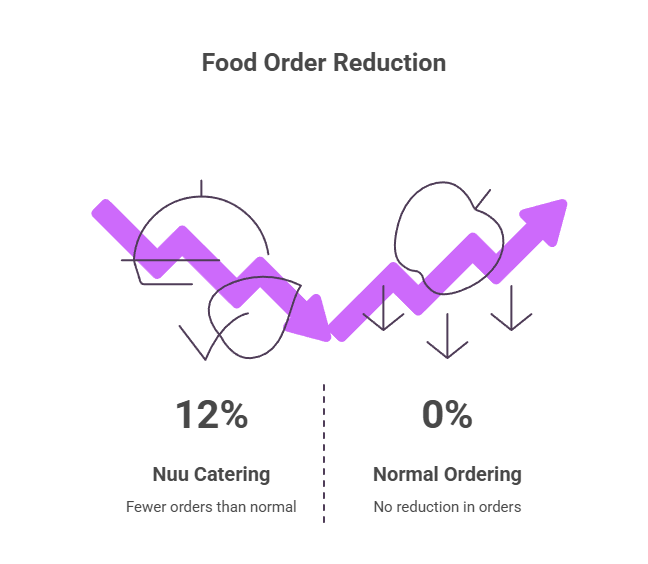
Results: Nuu Catering’s clients order 12% fewer than normal. Use a spreadsheet; look at the previous 4 week history of orders to determine order numbers.
Pro Tip: Stick to 6 – 8 mains; change them weekly; get varieties & not overwhelmed with food options.
Step 2: Demand Exact Counts
Buffet Killer: “Order for 60 people; but only 35 people show up” = 42% waste.
Solution: RSVP (pre-ordering) driven demand.
- Collecting pre-event polling: Nuu will collect; “yes or no & dietary restriction” no later than 48 hours before event starts.
- Buffer Rule: Use an additional 10% to cover for no-shows; never go over 10%.
- Real Time Adjustments: If five people have dropped off your RSVP list, remove 5 portions from your order.
Outcomes: (28% reduction in waste – Nuu Catering’s Data)
Step 3: Portion Control Without Skimping
Myth: Small servings = complaints.
Reality: Smartly sized satisfies everyone’s needs.
Tactics:
Boxed lunches that provide the exact amount needed per person.
Clear signage for buffet stations – “1 protein, 2 vegetables”.
Fruit/yogurt snack stations to prevent waste from main courses being over-gotten.
Psychological effects of smaller plates:
22% less food consumed from large plates (Cornell study). Nuu’s “Satisfying Standard Size” allows feedback from customers meaning “92% full”.
Step 4: Rotate & Refresh to Avoid Menu Fatigue
Repetitive menu items cause disinterest in food by week 4 and creates food waste.
Ways to Reduce Food Waste:
- Rotation of Themes – Monday bowls, Wednesday wraps, Friday comfort foods.
- Seasonal Specials will help provide new options eg: Asparagus in Ontario by April and BC blueberries by June.
- Collecting customer feedback on menu items “Do you want more poke?” will help with future menu choices.
Nuu has an 8-week cycle of anti-burnout to reduce food waste by 18% as compared to previous cycles.
Step 5: Tech for Precision Ordering
- Error-prone manual spreadsheets lead to errors, whereas the accuracy of apps can help reduce them.
- The Nuu platform allows users to create a poll or consolidate results and place orders with the exact desired items in the desired quantity.
- An example of an AI prediction is, “We had a 15% increase in taco orders over the last three Tuesdays.”
- Inventory is synchronized for partners and confirmed by all partner suppliers in real-time.
- The result was a 35% reduction in food waste for Foodservice Canada technology users.
Step 6: Partner with Donation Networks
- Edible surplus = opportunity.
- Second Harvest Toronto: The Nuu app will enable its partner retail stores to contribute up to 85% of their unused food.
- This is also available through companies like Too Good To Go as a corporate offering.
- Internal take-home baskets for staff.
- Canada tax credits up to 20% for donated food.
- Impact = zero landfill for 92% of Nuu customers.
Step 7: Educate Without Lecturing
Subtle nudges:
- Signage: “Do you love leftovers? Take home a doggy bag.”
- Gamification: “Slack badges for your efforts during ‘zero waste week.'”
- Sampling hints: “Try using a smaller scoop and you’ll get to try more varieties.”
Outcomes = 15% voluntary reduction in consumption.
Step 8: Track, Measure, Iterate
No metrics = no progress.
| Metric | Target | Tool |
| Waste % | <10% | Weigh bins |
| Over-order % | <12% | Poll vs actual |
| Satisfaction | >88% | Post-meal NPS |
Food Waste Prevention Strategies in Action: Case Studies
Case 1:
Toronto Fintech had previously wasted 28% of food ($2,800 per month), and now it has come down to 7% ($2,100 saved per month) through Nuu Catering’s improvements (the group did polls and portions of food donated to alleviate some of the waste).
Case 2:
The Vancouver Agency faces a challenge with employees working from home and over-ordering supplies. Nuu’s solution was to conduct monthly kit counts and track consumption. This reduced waste from 12% to 4%.
Conclusion
Successfully mastering ‘How to Reduce Food Waste’ will change cafes from cost centres to cultural heroes. Nuu has created food waste prevention strategies using the latest technology in tracking, managing, and donating food items and cafeteria menu planning (approximately 25-40% savings, while still providing you with good quality and enjoyment). You can also implement the current Nuu Catering program already in place in Toronto that generates an average of 8% food waste to help your organization achieve its corporate sustainability initiatives.
How to implement change: Audit your usage for 1 week; conduct a poll to gather information for next week; work with a partner. You will see savings compounding efforts and your team will have the satisfaction of knowing they are helping environmentally sustainable practices to become an everyday occurrence.
Click here to get your quote today!
FAQs
- How to reduce food waste in corporate cafeterias?
- Food waste prevention strategies start with counting/tracking exact quantities from polls, developing menus with data, portion control and donating food. Nuu clients achieved an 8% waste (vs 25% industry avg). Each client should track each week.
- What are effective food waste prevention strategies for offices?
- Effective food waste prevention strategies include using RSVP ordering (28% reduction), rotations (particularly 18% decrease in assorted items being thrown out due to fatigue), tech dashboards, and donating surplus food. Return on investment= $18k/year in the middle of the office.
- How does cafeteria menu planning reduce food waste?
- Cafeteria menus planning is based around data (polls and history) to eliminate over-ordering of food. No more than 6 to 8 items should be offered, and should rotate every 1 to 2 weeks- results show immediate waste reduction of 12%.
- What is the impact of cafeteria food waste on corporate sustainability initiatives?
- 25% of cafeteria food waste is a national $1.2b loss, 2.5 trillion tons of CO2 appear every year from this food waste. By employing strategies of polling/portioning/donating, corporate sustainability initiatives yield ESG credentials plus will offer 20% tax credits.