HR & Workplace Strategy
⏱ 12 min read
Table of Contents
Introduction
Why HR Managers Need to Understand Corporate Catering Terms
A. Corporate Catering & Service Models (Terms 1–10)
B. Menu & Dietary Terms (Terms 11–20)
C. Operational & Logistics Terms (Terms 21–30)
D. Budget & Billing Terms (Terms 31–40)
E. Workplace Meal Program Terms (Terms 41–50)
How to Choose the Right Corporate Catering Partner
Common Mistakes HR Managers Make
Nuu Catering: A Popular Choice
FAQs
Introduction
Corporate catering sounds simple at first glance, but for HR teams, it is a multilayered responsibility where they have to fulfill every demand and need.
Once you start ordering food for your employees, it turns into planning a structured meal program, understanding pricing models, handling preferences, and getting familiar with catering terms. Not understanding these terms can lead to miscommunication, unexpected costs, and food wastage.
✦
Finding difficulty in understanding these corporate catering terms?
This corporate catering glossary explains 50 essential terms that every HR should know in 2026. It helps you keep your catering smooth and stress-free.
✦
Why HR Managers Need to Understand Corporate Catering Terms
Corporate catering decisions impact budget, employee satisfaction, and logistics. Knowing these terms helps HR plan better meal programs, negotiate with vendors, and get structured service without hassle.
Clear knowledge guides HR to choose correct portion sizes, dietary requirements, and billing systems. Instead of approving simple menus, they can approve meal programs that align with office culture and employee wellness.
✦
Corporate Catering Glossary — 50 Essential Catering Terms
Corporate catering comes with its own set of terms, which can feel overwhelming at first. This glossary simplifies them so you can plan clearly and efficiently.
Section A
Corporate Catering & Service Models
| # |
Term |
Definition |
| 1 |
Corporate Catering |
A professional food service provided specifically for businesses. Includes daily office lunches that HR teams rely on to increase productivity and employee satisfaction. |
| 2 |
Meal Programs |
Recurring food services providing meals daily, weekly, or on a subscription basis. Designed for employees in a corporate setting within standardized budgets. |
| 3 |
On-site Catering |
Food is prepared and served directly at the company’s location. Requires kitchen access or temporary cooking setups. Perfect for large companies or corporate events. |
| 4 |
Off-site Catering |
Food prepared at an external kitchen and delivered to the workplace. Most common in companies without kitchen access — a convenient option for office lunches. |
| 5 |
Drop-off Catering |
Food delivered without full-service staff. Meals are packaged and labeled, ready to distribute. Cost-effective for team lunches with controlled portion sizes. |
| 6 |
Buffet Service |
A self-service catering format where food is arranged for guests to choose their own portions and combinations. |
| 7 |
Plated Service |
Meals individually portioned and served to guests. Mostly used in executive meetings and client dinners. Ensures controlled portions with presentable finishing. |
| 8 |
Hybrid Catering Model |
Combines multiple service styles — boxed meals for daily programs and buffet-style service for monthly events. |
| 9 |
Pop-up Catering |
A temporary food setup for a specific event or short-term need. Includes themed stations, guest chefs, and limited-time menus for celebrations or launches. |
| 10 |
Contract Catering |
A long-term catering agreement with a provider for ongoing services. Supports structured meal programs with defined prices and expected service levels. |
🍽️
See All Service Models in Action
From drop-off lunches to full buffet setups — explore Nuu’s corporate catering options for every team size.
✦
Section B
Menu & Dietary Terms
| # |
Term |
Definition |
| 11 |
Custom Menu Planning |
Designing a menu tailored to the company’s workforce — dietary needs, cultural diversity, budget limits, and portion planning to prevent wastage. |
| 12 |
Dietary Restrictions |
Limitations on food based on health, allergies, religious beliefs, or personal preferences — covers vegetarian, vegan, gluten-free, dairy-free, and more. |
| 13 |
Vegan Catering |
Meals without any animal-based ingredients — no meat, dairy, eggs, or animal-derived products. Supports plant-based preferences and sustainability goals. |
| 14 |
Gluten-Free Options |
Meals without wheat, barley, or related grains. Essential for employees with celiac disease or gluten sensitivity. |
| 15 |
Halal/Kosher Catering |
Catering that follows specific religious dietary laws. Halal follows Islamic guidelines; kosher follows Jewish dietary regulations. Both require clear labeling. |
| 16 |
Seasonal Menu |
Dishes using ingredients that are fresh and available during a specific time of year. Improves natural flavors through seasonal specialties. |
| 17 |
Calorie-Labeled Meals |
Meals that clearly display nutritional information per dish. Helps employees make better choices aligned with their fitness and wellness goals. |
| 18 |
Portion Control |
Standardized serving sizes that maintain consistency and reduce over-ordering or wastage. Helps HR accurately predict food quantities. |
| 19 |
Allergen Management |
Identifying and handling food allergens — nuts, dairy, shellfish, soy, gluten — through proper labeling and safety measures. |
| 20 |
Nutrition Compliance |
Ensuring food served meets proper dietary guidelines. Compliance-driven meal programs support long-term employee health initiatives. |
🥘 Browse Nuu’s Dietary-Friendly Menus
✦
Section C
Operational & Logistics Terms
| # |
Term |
Definition |
| 21 |
Headcount Estimate |
The number of people expected to be served. Helps the catering partner calculate food quantities and prevent shortages. |
| 22 |
Minimum Order Quantity (MOQ) |
The minimum amount of food or meals a caterer requires per order. Ensures cost efficiency and is commonly applied for small teams. |
| 23 |
Turnaround Time |
How long a caterer needs to prepare and deliver an order after confirmation. Critical for avoiding last-minute planning failures. |
| 24 |
Catering Logistics |
All operational steps for delivering and serving food — transportation, setup, serving flow, refilling, and cleanup. |
| 25 |
Service Staff Ratio |
Catering staff assigned per group of guests (e.g. 1 server per 25 employees). Affects service speed and overall dining experience. |
| 26 |
Food Holding Temperature |
The safe temperature range at which food must be maintained before serving. Ensures quality and safety during delivery and service. |
| 27 |
HACCP Compliance |
Hazard Analysis and Critical Control Points — food safety standards preventing contamination. Ensures meals are prepared, served, and stored safely. |
| 28 |
Vendor SLA |
A formal agreement covering food quality, delivery timing, hygiene standards, and issue resolution between a company and its catering provider. |
| 29 |
Setup & Breakdown |
Arranging and removing catering equipment before and after service — tables, serving stations, and waste management. |
| 30 |
Delivery Window |
A specific time range for food to arrive at your workplace. Ensures meals are served fresh and aligned with employee schedules. |
✨ Skip the Logistics Headache
Nuu’s AI Smart Order Handles It All
Auto-manages headcount, delivery windows, allergen flags, and split billing — so your HR team doesn’t have to.
✦
Section D
Budget & Billing Terms
| # |
Term |
Definition |
| 31 |
Per-Plate Pricing |
A fixed cost charged per individual served. Simplifies budgeting in corporate meal programs — HR can easily calculate total expenses. |
| 32 |
Corporate Catering Packages |
Predefined menu options and pricing that combine meals, beverages, setup, and service staff in a single cost. |
| 33 |
Subscription Meal Plans |
Weekly or monthly recurring meal arrangements to streamline daily or scheduled office lunches. |
| 34 |
Billing Cycle |
A scheduled timeframe in which catering invoices are generated — weekly or monthly. Helps HR manage approvals and payments efficiently. |
| 35 |
Cost Per Employee (CPE) |
Average catering expenses per employee. Tracking CPE helps HR adjust menus and services without exceeding budgets. |
| 36 |
Budget Cap |
Maximum amount allocated for catering within a period. Vendors adjust menus or portion sizes to align with your cap and prevent overspending. |
| 37 |
Volume Discount |
Reduced pricing for large meal orders. Best for large teams — maximizes value while maintaining food quality. |
| 38 |
Invoice Reconciliation |
Reviewing invoices to ensure accuracy before payment — verifying headcount, pricing, taxes, and charges to prevent overbilling. |
| 39 |
Cancellation Policy |
Terms for modifying or cancelling orders — deadlines, refund eligibility, and penalties to avoid unexpected charges. |
| 40 |
Deposit Requirement |
An upfront payment to confirm a catering booking. Secures date, menu preparation, and resource allocation — common for corporate events. |
📦
Catering Packages
Meals, setup & service staff — all bundled in one transparent price.
Explore packages →
👥
Order Together
Group ordering with split billing — no spreadsheets, no chasing people.
Try group ordering →
✦
Section E
Workplace Meal Program Terms
| # |
Term |
Definition |
| 41 |
Employee Meal Program |
A structured food service plan provided regularly to company staff — daily lunches, subsidized meals, or scheduled catering support. |
| 42 |
Daily Office Lunch Program |
A recurring catering arrangement providing lunch every workday with rotating menus and portion planning. |
| 43 |
Event Catering |
Food service for one-time corporate events — conferences, product launches, or team celebrations with customized menus. |
| 44 |
Festive Catering |
Themed menus for holidays or workplace celebrations, aligned with cultural events, milestones, or seasonal occasions. |
| 45 |
Wellness Meal Program |
Nutritionally balanced meals supporting employee health — calorie-based options and health-conscious ingredients. |
| 46 |
Executive Dining |
A premium catering service for leadership meetings or VIP guests, with plated service and curated menus. |
| 47 |
CSR Catering Initiatives |
Integrating corporate social responsibility into food programs — local vendors, community kitchens, or donating surplus food. |
| 48 |
Sustainable Catering |
Environmentally responsible food sourcing and service — eco-friendly packaging and waste reduction practices. |
| 49 |
Zero-Waste Catering |
Minimizing food waste and environmental impact through accurate portion planning and responsible disposal systems. |
| 50 |
Feedback Loop System |
Collecting employee reviews after meal service via surveys, ratings, and digital tools to improve service quality. |
✦
How to Choose the Right Corporate Catering Partner
Checklist
✓Choose a partner with experience in workplaces of your size.
✓Verify food safety certifications and hygienic standards.
✓Look for customizable menus that accommodate diverse dietary needs.
✓Review their SLAs for delivery and quality guarantees.
✓Choose a partner that offers responsive and supportive service.
✓Check client testimonials and long-term corporate partnerships.
✓Confirm their pricing systems match your needs and demands.
✦
Common Mistakes HR Managers Make in Corporate Catering
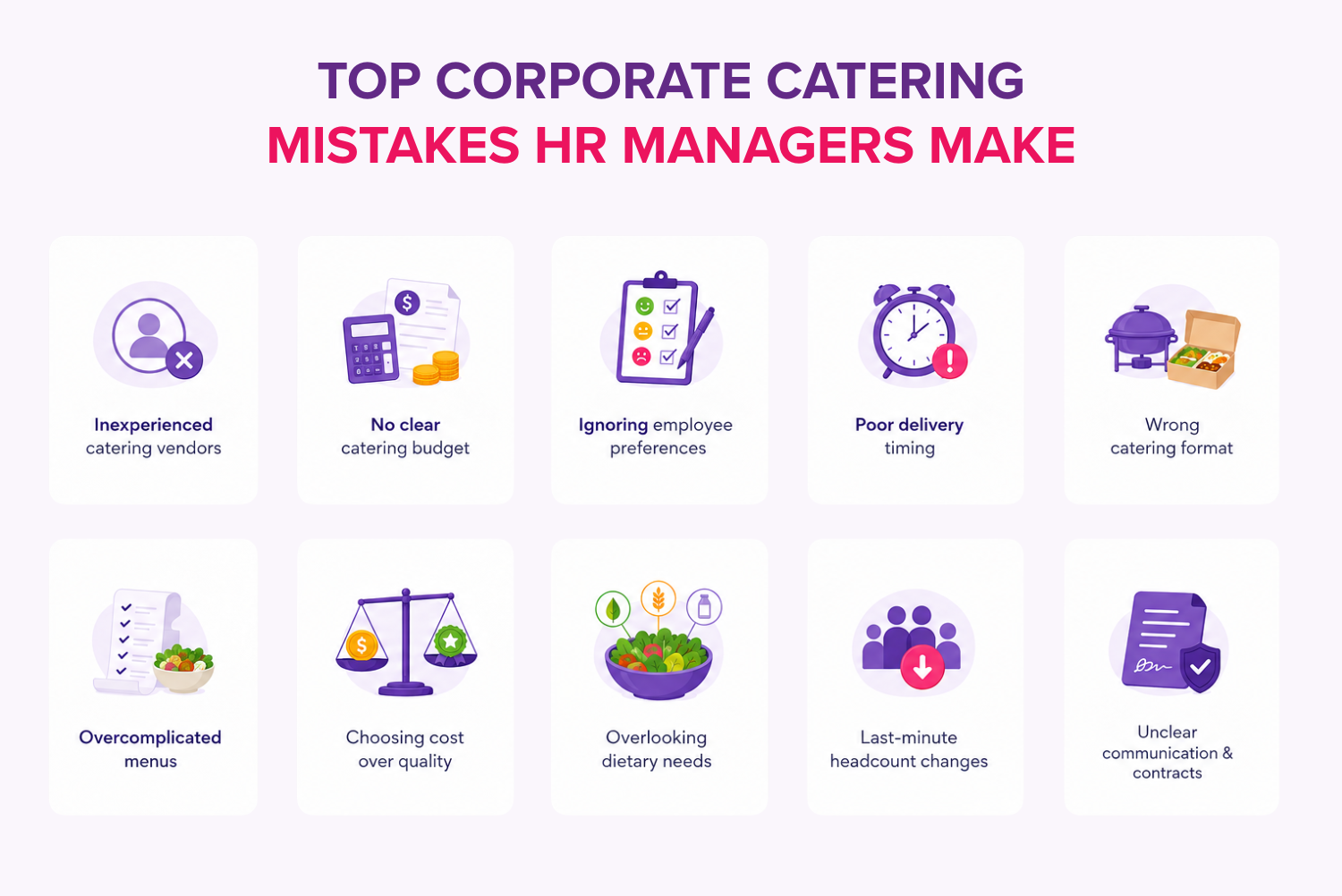
⚠️Working with inexperienced vendors
⚠️No clear budget
⚠️Ignoring employee feedback
⚠️Poor delivery & timing planning
⚠️Wrong catering format selection
⚠️Overcomplicated menus
⚠️Choosing price over quality
⚠️Ignoring dietary and allergen needs
⚠️Late headcount confirmation
⚠️Unclear contracts with poor communication
✦
Nuu Catering: A Popular Choice in Corporate Catering & Office Meal Programs
When it comes to corporate catering, Nuu Catering is a trusted name for many companies. We simplify lunch needs without hassle — from daily meal planning to large team lunches and corporate events. Our focus always remains on delivering nutritious office lunches. We help HR managers run smooth meal programs with properly curated menus and transparent catering terms that solve challenges at once.
Final Bite
Understanding the vocabulary of corporate catering is no longer optional. Knowing these terms helps HR managers structure well-balanced meal programs without confusion — enabling smarter negotiations, better planning, and office lunches that employees genuinely enjoy.
Ready to simplify corporate catering without any guesswork?
Partner with Nuu Catering to design meal programs that fit your team, budget, and workplace culture. With the best quality and transparent pricing, start planning your corporate catering today.
Get Started with Nuu Catering
✦
FAQs About Corporate Catering Glossary
Q1
How do corporate meal programs benefit companies?
They boost productivity, increase work ability, are cost-effective and convenient, and improve collaboration among employees.
Q2
What should HR managers know about corporate catering trends in 2026?
In 2026, corporate catering focuses on zero wastage, balanced nutrients, DIY customizations, and food ordering apps.
Q3
How important is dietary compliance in corporate catering?
Very important — corporate food must be diverse in choices, and allergies and nutrient intake must be carefully managed for all employees.