
AI Summary
Table of Contents:
Introduction
How Food Delivery Companies Fees & Markups Affect Toronto Office Budgets
Why Toronto Offices Underestimate Food Delivery Costs
What Service Fees Delivery Companies Charge
How Markups Work and Why Two Identical Orders Can Cost Different Amounts
6 Factors That Influence Office Food Delivery Pricing in Toronto
How to Calculate the True Per-Person Cost
5 Ways Toronto Offices Can Reduce Delivery Fees Without Reducing Meal Quality
How Nüu Catering Helps Toronto Offices Simplify Food Delivery Costs
Final Thoughts
Frequently Asked Questions About How Much Do Food Delivery Companies Charge Toronto Offices
Lunch ordering for a Toronto office looks easy at first, like picking a restaurant, placing the order, and waiting for delivery. But once the bill comes in, many teams realize the final cost is much higher than expected.
The imbalance while ordering food comes from differences in the costs that you do not notice in the first point.
- Platform handling fees
- Order minimums
- Restaurant price adjustments
- Peak-time surcharges
- Packaging or admin charges
For offices in Brookfield Place along Bay Street or anywhere in the Toronto Financial District, those extra costs can add up fast when lunch orders are frequent.
In this blog, you will know about what service fees delivery companies charge, how markups work and how to calculate the true per-person cost so you can budget with more confidence.
How Food Delivery Companies Fees & Markups Affect Toronto Office Budgets
When you place an office lunch order, the menu price is only the starting point. Once delivery fees, service charges, markups and taxes are added, the final invoice can be much higher than expected.
For example, a meal that costs $20 on the menu ends up costing $28 or more after fees and taxes are added.
This happens because delivery apps charge on multiple levels. For a small team, this might not feel like a big deal, but for Toronto offices ordering lunch for 20, 50 or 100 people, these charges pile up with time.
Final Note: Understanding food delivery companies fees & markups for Toronto offices helps businesses create more accurate lunch budgets by avoiding unexpected expenses.
Why Toronto Offices Underestimate Food Delivery Costs
Most office managers focus on the price besides the meal and this is the only part of the story. But the reality is several additional expenses may apply before the food even reaches your workplace.
Common overlooked costs include:
- Delivery fees
- Platform service fees
- Menu markups
- Peak-hour surcharges
- Packaging costs
- Taxes
- Optional tips
Businesses ordering from busy areas like the Bay Street corridor or King Street West during lunchtime experience higher demand, making delivery costs less predictable.
What Service Fees Delivery Companies Charge
One of the biggest questions businesses ask is what service fees delivery companies charge. Although every platform is different, these are some of the most common charges:
Delivery Fee: This covers the transporting food cost from the restaurant to your office.
Service Fee: This is a percentage of your total order, meaning between 10% and 25%.
Platform Fee: A small charge just for using the app or website.
Small Order Fee: Orders below a minimum value may include additional charges.
Peak-Time Charges: Ordering during busy lunch hours can increase delivery costs.
Packaging Fee: Some providers charge extra for containers, cutlery and other packaging materials.
Rush Fee: If you need a last-minute or same-day order, some platforms charge extra.
The best approach is to review the complete breakdown before confirming an order instead of looking only at the menu price.
How Markups Work and Why Two Identical Orders Can Cost Different Amounts
Many businesses wonder how markups work. Here is a simple example.
Imagine two employees ordering the exact same lunch from the same restaurant. One orders directly from the restaurant and the other orders through a delivery platform.
Even though the meals are identical, the final prices may differ. The menu price you see on a delivery app is not the same price the restaurant charges in-store. As many delivery companies add a markup directly to each item between 10% and 30%.
So the same sandwich that costs $12 in-store might show up as $15 on the app. This is the reason two offices ordering the exact same meal can end up with different totals.
6 Factors That Influence Office Food Delivery Pricing in Toronto
Every office order is different. Here are six factors that influence pricing.
1. Team Size
Large orders may give you better value because the cost is spread across more meals, whereas the smaller orders can sometimes come with extra fees, which can raise the total price.
2. Delivery Distance
If the restaurant is far from your office, the delivery fee will be higher, as it takes longer to travel That is why nearby restaurants help keep office lunch orders more affordable.
3. Order Timing
Lunch hours are the busiest time for food delivery. As many offices place orders at the same time, delays can happen. Therefore, planning ahead can help avoid rush-hour problems.
4. Menu Selection
Premium meals cost more because they use better ingredients that take more time to prepare. If your team chooses specialty dishes or larger portions, the total invoice can go up quickly.
5. Weather conditions
On Toronto’s hot summer days, demand for cold drinks, salads and light meals rises. So delivery demand across the city also rises, which automatically increases the overall cost.
6. Multiple Restaurant Orders
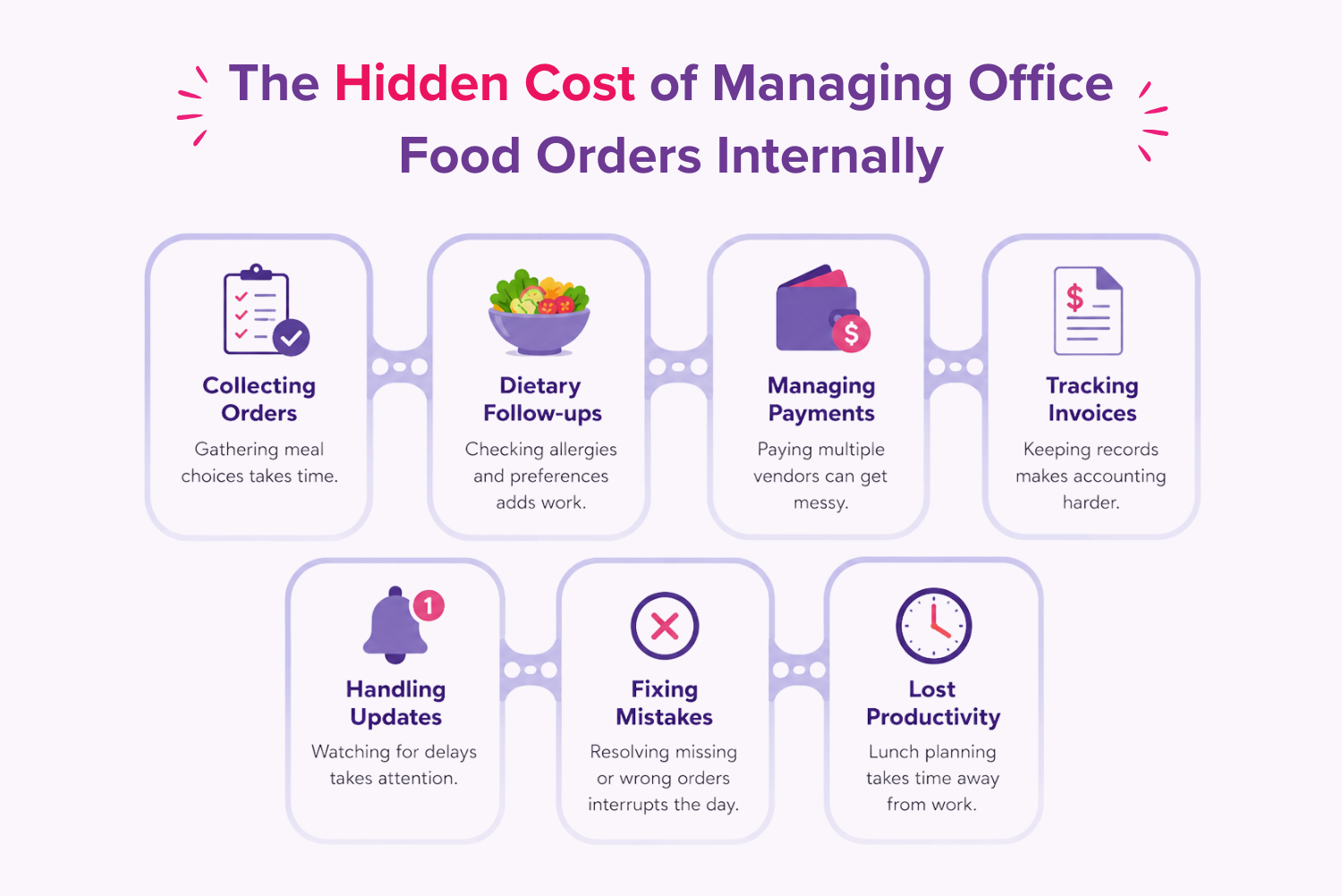
Ordering from several restaurants at once takes more time and planning. Someone has to collect the orders, check the detail and make sure everything arrives together.
Gist: For offices looking for variety, meals from Nüu Catering partners such as What-A-Bagel, Pumpernickels, Freshii, Mad Radish, Naan Kabob, Café Landwer and Union Chicken offer different cuisines while keeping employees happy.
How to Calculate the True Per-Person Cost
One of the easiest ways to control office lunch spending is learning how to calculate the true per-person cost. Here are the steps for how you can calculate it per person:
Step 1: Take the total order amount including all fees and tax.
Step 2: Divide it by the number of people eating.
Step 3: Compare that number to the average menu price per person.
Use this simple formula:
True Per-Person Cost = Total Invoice ÷ Number of Employees
For example:
- Food: $900
- Delivery Fees: $50
- Service Fees: $65
- Taxes & Other Charges: $110
Total Invoice = $1,125
If 45 employees are eating, so $1,125 ÷ 45 = $25 per employee
This gives businesses a much clearer picture of actual meal costs than menu prices alone.
5 Ways Toronto Offices Can Reduce Delivery Fees Without Reducing Meal Quality
Reducing office food delivery costs does not always mean compromising on quality. With these simple strategies you can manage expenses while still keeping employees satisfied.
- Combine all separate orders into one delivery to reduce multiple delivery charges.
- Finalize headcounts before placing an order to avoid paying for extra meals.
- Rotate restaurant choices based on your team’s preferences to minimize food waste.
- Choose restaurants that are located closer to your office that will reduce delivery time plus transportation costs.
- Choose a reliable corporate catering partner that streamlined office ordering.
How Nüu Catering Helps Toronto Offices Simplify Food Delivery Costs
For businesses ordering lunch regularly, transparency matters as much as food quality. Nüu Catering simplifies office food delivery by bringing together a wide range of trusted restaurant partners on one platform.
Whether your team prefers:
- Healthy bowls from Harvest Clean Eats
- Mediterranean dishes from Café Landwer
- Breakfast from What-A-Bagel
- Pizzas from Lambretta Pizzeria
- Barbecue from Benny’s Barbecue
- Fresh poke bowls from Pokeworks
- Wraps from Freshii
Offices can enjoy greater variety without managing multiple vendors. This helps Toronto workplaces order more easily while saving time, reducing coordination hassles and keeping catering costs more transparent.
Final Thoughts
Office food delivery involves more than getting meals to the workplace. For Toronto businesses, understanding food delivery companies fees & markups for Toronto offices makes it easier to plan budgets, compare options and avoid unexpected charges later on.
When companies know what service fees delivery companies charge, how markups work and how to calculate the true per-person cost, they can make better ordering decisions that support both their team and their budget.
Looking for a smarter way to manage office lunches?
Explore how Nüu Catering can simplify ordering with diverse restaurant choices and a streamlined experience for Toronto workplaces.
Frequently Asked Questions About How Much Do Food Delivery Companies Charge Toronto Offices
1. How do food delivery markups work?
Food delivery markups occur when the final price includes additional platform costs such as delivery, service or convenience fees. It is better to always compare the complete invoice instead of the menu price alone.
2. What affects corporate catering pricing in 2026?
Factors such as team size, delivery distance, menu selection, order timing, dietary requirements and operational costs continue to influence corporate catering pricing in 2026.
3. Is office food delivery cheaper than individual ordering?
Yes, group ordering reduces delivery costs, simplifies logistics and makes budgeting easier compared to multiple individual orders.