
AI Summary
Table of Contents:
Introduction
Why Food Delivery Is More Complicated for a Distributed Canadian Team
10 Steps to Set Up Food Delivery for a Distributed Team in Canada
Mistakes to Avoid When Setting Up Food Delivery for a Distributed Team
How Nüu Catering Simplifies Food Delivery for Team Meals
Final Thoughts
Frequently Asked Questions
| Key Takeaways Setting up food delivery for a distributed Canadian team starts with understanding where your employees work and what each location needs.Choose delivery options that match different office sizes, schedules and team preferences.Create clear rules for budgets, ordering and employee eligibility before placing orders.Check coverage, restaurant options and support when learning how to onboard a delivery service nationally.Manage dietary needs and meal choices in one organised system.Plan carefully for teams working in different time zones and test the process before scaling. |
How do you manage team meals when your employees are not all in one place? A team meal sounds simple but it quickly gets complicated when people are spread across different locations.
One group may be in the Toronto Financial District and another near Bay Street. The rest are across GTA offices or working remotely from home. Suddenly, one lunch order turns into multiple decisions.
- Who is placing the order?
- Which restaurant works for each location?
- How do you handle dietary needs?
- What time should everyone order so everything arrives smoothly?
Even small things start to matter. On hot Toronto summer days, teams may want lighter meals, cold drinks or easy office delivery instead of sending someone out to pick up food. That is why companies need a proper system when they set up food delivery for a distributed team in Canada.
In this blog, we’ll break it down step by step from mapping employee locations and managing preferences to setting budgets and planning delivery for a distributed Canadian team.
Why Food Delivery Is More Complicated for a Distributed Canadian Team
A single office has one delivery address, one lunch schedule and one group of people to coordinate. But a distributed team is different. An office near Brookfield Place in Downtown Toronto may have different lunch needs from a team based in North York, Scarborough or Etobicoke.
Restaurant availability can also change by location. A team may want breakfast options such as What-A-Bagel, while another office may prefer Mediterranean meals from Naan Kabob, healthy options from Mad Radish or a mix of cuisines through a group order.
10 Steps to Set Up Food Delivery for a Distributed Team in Canada
The challenge is to keep the experience organized without making every office manager chase employees for meal choices. A clear process helps. So there are 10 steps to make food delivery easier for a distributed team.
Step 1: Identify Where Your Employees Are Located
It is the very first step to find out where everyone works. Make a list of your main offices, satellite locations and remote employee groups. Your team may include employees working in:
- Downtown Toronto
- The Financial District
- Liberty Village
- North York
- Scarborough
- Etobicoke
- Other GTA business hubs
You should also note how many employees are based at each location. A 50-person office needs a different ordering process from a small team of 10. This step sounds basic. But most delivery mix-ups happen because companies skip it.
Step 2: Choose the Right Delivery Option for Each Location
Not every team needs food delivered in the same way. A large office may prefer a shared lunch spread, whereas a smaller group needs individual meals. Every office needs different options for different occasions, like:
Breakfast meetings: Bagels, pastries, coffee and breakfast sandwiches
Weekly team lunches: Individual meals or sharing platters
Large meetings: Buffet-style catering
Training sessions: Easy-to-distribute boxed lunches
Office celebrations: A mix of mains plus desserts and drinks
| Do You Know? For Toronto offices, Nüu brings together restaurant options including What-A-Bagel, Café Landwer, Mad Radish, Freshii, Naan Kabob, Lambretta Pizzeria, Pokeworks and more. This gives teams different cuisines and meal styles to choose from. |
Step 3: Create a Clear Food Delivery Policy
Before employees start ordering, set some simple rules. Your policy does not need to be complicated. So it is important to keep the policy short because long documents do not get read. A one-page guide works better than a 10-page manual nobody opens.
It should answer questions such as:
- Who can participate?
- What is the budget per person?
- Which occasions qualify for company-paid meals?
- Is there an order deadline?
- Can employees choose their own meals?
- Who approves larger orders?
- What happens if someone misses the deadline?
Share it with the whole team so everyone knows the rules from day one.
Step 4: How to Onboard a Delivery Service Nationally
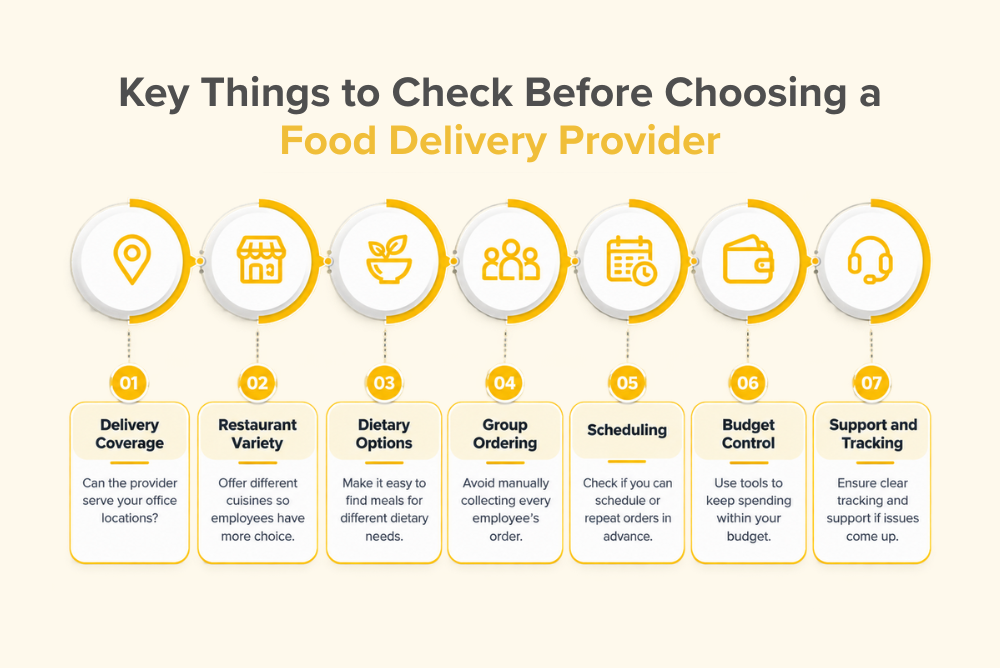
Onboarding a delivery partner across Canada needs proper planning. First, check which cities the provider covers, then review the restaurant variety in each area. Also consider billing if multiple locations will create separate invoices. After all this planning, you need to check other certain things like
- Advance scheduling
- Group ordering tools
- Dietary information
- Delivery tracking
- Customer support
- Recurring meal options
Step 5: How to Manage Preferences Across Locations
Learning how to manage preferences across locations is important when your team has different dietary and cultural needs. Some employees want quick bites like bagels or sandwiches and others prefer heartier meals or classic deli-style options.
So it is best to collect basic dietary preferences like vegetarian, vegan, halal, gluten-free, etc. in advance and use them when choosing menus and restaurants.
The process is simple:
Collect preferences → Keep them updated → Offer suitable choices → Review needs regularly
Step 6: What to Do for Teams in Different Time Zones
Canada spans multiple time zones, which means a lunch in Toronto is not lunch in Vancouver. Set delivery windows based on each region’s local time, not head office time. This keeps meals fresh and on schedule for everyone.
This is best to plan deliveries around the local lunch schedule because advance scheduling can be helpful for large meetings or company-wide events. This gives the provider and your internal team more time to coordinate.
Step 7: Set a Budget for All Locations
A distributed meal program needs a clear budget. Start with a basic per-person amount. Then decide whether that amount includes food only or also covers delivery and other charges. The goal is to create a fair system without assuming every order will cost exactly the same.
You may also want separate budgets for different occasions. For example, a regular team lunch may have one budget, while an annual celebration or client event may have another. For recurring programs, calculate your expected monthly spending before launching. This gives your team better cost control as the program grows.
Step 8: Have a Backup Plan for Delivery Issues
Deliveries do not always go smoothly. Traffic, weather or a closed restaurant can change your plans. You even face more problems like a restaurant may be unavailable, an item may sell out or a delivery may be delayed.
To fix this problem, choose an alternative restaurant before you need one. For example, if your first choice is unavailable, having another suitable option from a curated restaurant list can save time. Planning ahead can make these situations much easier to manage.
Step 9: Test Your Food Delivery Plan First
You do not have to launch your program everywhere on day one. Start with small efforts. Choose one or two locations and run a trial. Then ask employees for feedback, which must include
- Was ordering easy?
- Were there enough choices?
- Did the food arrive on time?
- Did the budget work?
- Were dietary needs handled properly?
This feedback will help you to improve the process. With real feedback, you can make the true difference that can satisfy your employees.
| Planning Tip Before introducing food delivery across every location, start with one or two offices and test the process. Review whether orders arrive on time, employees have enough meal choices, dietary needs are handled properly and the budget works as planned. Use the feedback to improve the process before expanding it to the rest of your distributed team. |
Step 10: Track Results and Improve Your Program
Food delivery should not be a set-it-and-forget-it process. Review the program regularly. Track simple numbers, such as
- Participation rates
- Average cost per order
- Delivery reliability
- Number of order issues
- Employee feedback
- Popular meal options
- Frequency of recurring orders
You may notice that one office prefers individual meals while another enjoys sharing platters. Use that information so that every need can be met.
Mistakes to Avoid When Setting Up Food Delivery for a Distributed Team
Managing food delivery for a distributed Canadian team can quickly become complex.
With employees spread across multiple locations, a clear system is essential. These are some of the common mistakes you should not make while setting up food delivery for a distributed team in Canada.
1. Treating Every Location the Same
Different offices have different team sizes, schedules and restaurant access. Build consistency where possible, but leave room for local needs.
2. Ignoring local landmarks and zones
Delivery near busy areas like Bay Street or Brookfield Place needs different timing than quieter neighbourhoods.
3. Waiting Until the Last Minute
Large orders need proper planning. So avoid rushing to organize food on the morning of an important meeting.
4. Ignoring Dietary Needs
A team meal should not leave some employees with no suitable options. Collect preferences and review menus before ordering.
5. Using Unclear Order Deadlines
This is particularly important for teams in different time zones. Thus, always state the correct deadline clearly.
6. Managing Everything Through Spreadsheets
Spreadsheets can work for small tasks but manually collecting dozens of meal choices can become difficult. Use an organized ordering process when possible.
7. Forgetting About Backup Options
A second restaurant choice can save an important team lunch when plans change.
8. Never Asking for Feedback
This is meant for the employees to make them comfortable. Their feedback can help you choose better meals and improve the ordering process.
9. Forgetting seasonal changes
Toronto’s hot summer days call for lighter meals, whereas winter needs warmer comfort food. Because a rigid menu does not work all year.
How Nüu Catering Simplifies Food Delivery for Team Meals
When you are setting up food delivery for a distributed team, you need more than just a restaurant to order from. You need a process that makes planning, ordering and coordination easier.
Where Nüu Catering Fits Into the Process
Planning team meals
You can choose from a variety of restaurant options for different occasions whether it is breakfast, a team lunch or a larger office gathering.
Letting employees choose their meals
With group ordering, employees can select their own meals instead of one person collecting every order manually.
Handling different team preferences
A wider choice of restaurant partners can make it easier to plan meals around different tastes and dietary preferences.
Coordinating GTA office locations
Best for teams working across nüu’s service areas including Downtown Toronto, the Financial District, Liberty Village, North York, Scarborough and Etobicoke.
Keeping larger orders organised
Order tracking and concierge support can help teams manage bigger or more complex workplace food orders.
Final Thoughts
Setting up food delivery for a distributed Canadian team takes some planning but it does not have to be complicated. All you need is to understand where employees work, what they need and how each location operates. Then start with a clear policy and budget. Then choose suitable delivery options, organize preferences and plan carefully for different schedules.
Want a stress-free way to feed your whole team, wherever they are?
Place your group order with Nüu Catering today.
Frequently Asked Questions
1. What should companies track after launching a food delivery program?
Companies should track participation, average spending, delivery reliability, employee feedback and common order issues. With these changes you can improve the overall experience.
2. Can companies offer food delivery for virtual team meetings in 2026?
Yes, companies can arrange meals for employees during virtual meetings or team events, depending on their budget, delivery coverage and the locations of participating employees.
3. What types of occasions are best for offering team food delivery?
Team food delivery can work well for office lunches, all-hands meetings, training sessions, client meetings, celebrations and recurring team meals. The best option depends on the purpose of the event and the team’s schedule.