

AI Summary
Table of Contents:
Introduction
What Cross-Contamination Really Means in a Catering Kitchen
Why Office Catering Carries More Risk Than a Restaurant Meal
7 Ways of How Caterers Prevent Cross-Contamination
What Certifications Cover Food Safety at a Catering Company?
Allergen Labelling: What Should You Expect From a Toronto Caterer?
What to Ask About Allergen Protocols Before Booking a Caterer
Red flags that should make you pause
A Toronto Corporate Catering Allergen Checklist
How Nüu Catering Approaches Dietary Requirements and Meal Labelling
Final Verdict
Frequently Asked Questions
| Key Takeaways Allergen safety starts before cooking with ingredient checks, storage and preparation controls.Cross-contamination can happen at any stage including preparation, packing and delivery.Food-handler certification matters, but it does not by itself confirm a caterer’s allergen-control process.Ask specific questions about ingredient verification, cleaning, meal labelling and how allergy-specific meals are kept separate. |
Let’s be honest! The lunch arrives at 12:15. Boxes are lined up across the office kitchen. Someone is checking names, another person is handing out meals and everyone is ready to eat. Then one employee asks, “Which one is mine? I have a nut allergy.”
Suddenly, lunch is no longer just about who ordered what. This is where catering companies handle allergens and cross-contamination in Toronto becomes important.
A reliable process involves checking ingredients, controlling preparation areas, cleaning equipment, training food handlers and clearly identifying special meals before they reach the office. Even on hot summer days proper food handling and delivery become another practical part of the equation.
In this blog, you will know about how Toronto catering companies handle allergens and cross-contamination along with what certifications are required and things to give more attention.
What Cross-Contamination Really Means in a Catering Kitchen
The word “contamination” sounds like something is wrong. In a kitchen, it is much smaller than that.
| Cross-contact (Quick Answer) A tiny, invisible amount of an allergen moving from one food to another. This can happen because of a shared cutting board, a serving spoon used in two dishes, unwashed hands or flour dust in the air. |
It can happen in places that are easy to overlook. The food looks fine and it still tastes fine. But for someone with a real allergy, this small amount of contaminated food is enough to cause a reaction. Even packaging can become part of the process.
The Canadian Food Inspection Agency identifies equipment, employees, storage, cleaning and shared preparation areas as possible sources of cross-contamination.
Why Office Catering Carries More Risk Than a Restaurant Meal
Ordering one meal for yourself is different from ordering lunch for an entire office.
In a restaurant, the kitchen is working with one table’s order at a time but in corporate catering, it involves many menu items, different restaurants, individual dietary requirements and one delivery containing dozens of separately packaged meals.
Here are some of the few reasons office catering needs extra care:
Shared platters: One serving spoon moving between two trays is the most common way allergens spread at a catered lunch.
Food sits out longer: Trays left on a boardroom table for hours give more time for spills and mix-ups.
Multiple kitchens, one order: A single office order can include dishes from several restaurants, each with its own kitchen habits.
Toronto’s hot summer days: Warm weather makes food safety even more important. Heat speeds up bacteria growth and makes proper storage and timing more crucial.
7 Ways of How Caterers Prevent Cross-Contamination
Knowing how caterers prevent cross-contamination starts with looking at the complete food journey rather than focusing only on the final meal. Here is what that system actually looks like inside a well-run Toronto kitchen.
1. Identify Allergens in Ingredients
The first step happens before cooking. A caterer needs to know what is actually inside an ingredient, not simply what the finished dish is called. Ingredient information also needs to be checked when suppliers or products change.
CFIA guidance notes that allergen cross-contact can occur because of ingredient substitutions, changes in suppliers, incorrect ingredients or unknown ingredients. This is why a good allergen process starts with the ingredient list.
For an office order, communicating the specific allergy is the best possible solution rather than writing “dietary restriction.” That gives the catering team something concrete to work with.
2. Control Allergen Storage
Storage is another point where cross-contact can occur. Allergen-containing ingredients should be stored in a way that reduces the chance of contacting other foods. It is preferred to clearly identify allergenic ingredients by keeping them separated and storing them below non-allergen foods.
This matters in busy kitchens where multiple ingredients are being used throughout the day. A spilled ingredient should not become a problem for another preparation area. For a catering company, storage is part of the allergen-control process.
3. Use Dedicated or Clearly Identified Equipment Where Appropriate
Shared equipment can create another cross-contact point. You should keep these things separate while preparing food, which are:
- Cutting boards
- Knives
- Tongs
- Mixing equipment
- Preparation counters
- Containers
- Frying equipment
Dedicated equipment is useful as where equipment is shared as well as cleaned, healthy food becomes more important. Some kitchens use color-coded cutting boards and tools where one color is kept only for allergen-free prep. This is best to avoid any confusion.
4. Follow Cleaning and Sanitation Procedures
Cleaning is one of the biggest parts of allergen control. A surface can look spotless but still require proper cleaning before another meal is prepared. For caterers, the deep cleaning means cleaning:
- Preparation surfaces
- Utensils
- Equipment
- Containers
- Areas where ingredients are handled
5. Train Food-Handling Staff
An allergen process only works when employees understand the real meaning of it. Staff need to know how dietary requests are communicated, how ingredients are handled and what to do when they are unsure about an ingredient.
Train your staff to change gloves, clean stations and cook allergen-free dishes first, while the equipment is still clean. This should not be a one-time lesson; rather, it has been a habit built into every shift.
6. Verify Ingredients Before Preparation
Recipes can change, suppliers can change and even packaged ingredients can change. That means an allergen check should not rely entirely on what meal was ordered last time.
It is identified that changes or substitutions in ingredients and suppliers are one of the main sources of allergen causing. This is relevant when ordering from restaurants through a catering platform.
Therefore, if an allergy is medically important, tell the caterer clearly and ask them to confirm the specific meal and preparation requirements rather than assuming a menu label tells the whole story.
7. Separate Allergen-Specific Meals During Packing
The final kitchen step is not the end. Meals still need to be packed and identified correctly. Individual packaging can make this easier because a special meal is not sitting in a large shared tray where it can be mixed up with another person’s food.
Clear labeling also helps employees quickly identify their meals. Nüu’s corporate catering model uses individual meals and dietary labels, with its website describing labels for requirements such as halal, vegan and gluten-free.
What Certifications Cover Food Safety at a Catering Company?
When vetting a Toronto catering company, ask about both food-handler training and broader food-safety systems. A few terms you may come across include
Food Handler Certification: Covers safe food handling, preparation and service. Ontario requires at least one certified food handler or supervisor to be on site during operating hours.
HACCP: A preventive approach that identifies food-safety hazards and establishes controls to reduce them.
SFCR: Canada’s federal food-safety regulations. Certain food businesses must meet SFCR requirements and maintain preventive controls.
Allergen Training and Controls: Focuses on managing allergens and reducing cross-contact through practices such as ingredient handling, cleaning and preparation.
Allergen Labelling: What Should You Expect From a Toronto Caterer?
A label should make the meal easier to identify, not create another guessing game. For corporate catering, this becomes useful when several employees have different requirements.
Labels should reflect verified information such as
- Each meal should show what is inside, not just a vague “may contain” sticker on everything.
- Halal, vegan, gluten-free and nut-free items should be marked clearly before the food leaves the kitchen.
- Labels should stay attached and visible from the kitchen to your office, whether it is in an office tower on Bay Street or a startup floor in Liberty Village.
For a real allergy, an individually boxed and labelled meal is safer than a shared platter. It can save employees from opening multiple containers or asking an organizer which meal is theirs.
| Planning a corporate lunch with several dietary requirements? Nüu Catering can help you organise individual meals and clear dietary identification in one office order. |
What to Ask About Allergen Protocols Before Booking a Caterer
If you are wondering what to ask about allergen protocols, do not settle for a simple yes, we accommodate allergies. Ask specific questions like
- Can you show me the ingredient list for each dish?
- How do you handle a nut-free order in a kitchen that also uses nuts?
- Are meals labelled per person?
- What happens if a dietary need is flagged the morning of?
- Are your restaurant partners checked for food safety?
- Can I filter the menu by allergen before I order?
- Who do we contact if something’s wrong on delivery day?
Red flags that should make you pause
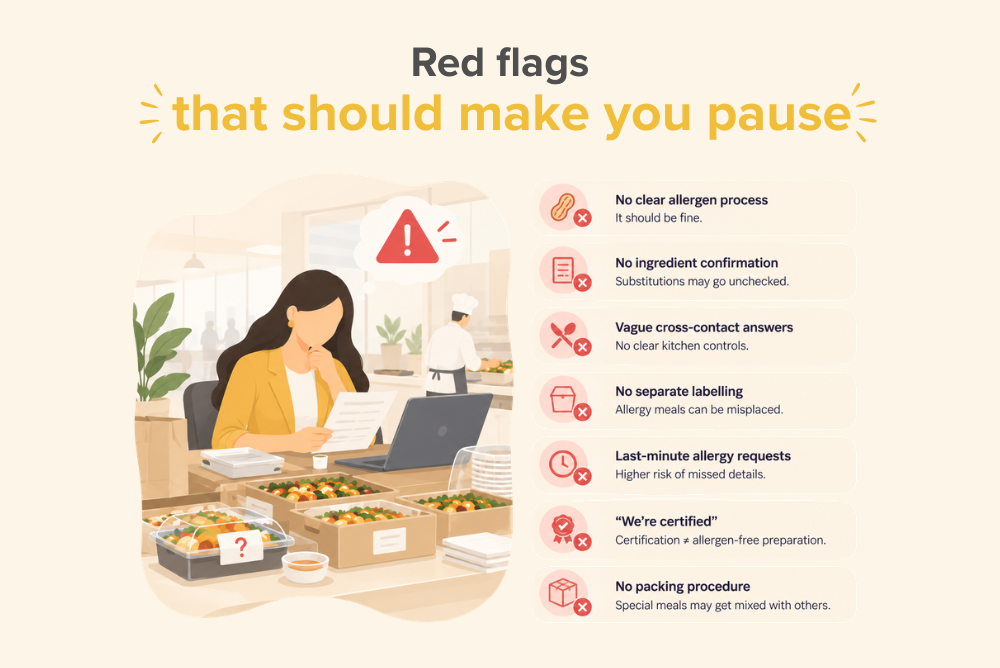
It should be fine: No clear allergen process
No ingredient confirmation: Substitutions may go unchecked
Vague cross-contact answers: No clear kitchen controls
No separate labelling: Allergy meals can be misplaced
Last-minute allergy requests: Higher risk of missed details
We’re certified: Certification ≠ allergen-free preparation
No packing procedure: Special meals may get mixed with others
A Toronto Corporate Catering Allergen Checklist
Before placing the order:
- List every allergy separately.
- Distinguish allergies from preferences.
- Confirm the number of special meals.
- Ask about allergen protocols.
- Check how meals will be labelled
Before delivery:
- Confirm the final meal count.
- Confirm special meal requirements.
- Ask how allergen-specific meals will be identified.
When food arrives:
- Check labels before distributing meals.
- Keep special meals identifiable.
- Avoid moving meals between containers.
- Make sure employees receive the correct meal.
This becomes useful for large offices where the delivery arrives at a central reception desk before being distributed across several floors.
How Nüu Catering Approaches Dietary Requirements and Meal Labelling
Corporate catering is different when every employee has their own meal preference. For group lunches, our Order Together feature lets each person pick their own meal and flag their own needs and orders arrive individually labelled instead of on one mixed tray.
We also provide offices to choose meals of their own choice from many restaurant options like What-A-Bagel, Café Landwer, Mad Radish, Naan Kabob, Pokeworks, Azul, Chop Hop and other Toronto restaurants.
Every menu shows halal, vegan, gluten-free, and kosher-style options before you even start building an order. Thus, our motive is to provide dietary information before the meal reaches the office, not after someone discovers an issue at lunchtime.
Final Verdict
Cross-contamination is not something that you should fear; it is something that needs to be taken care of with proper planning. It starts with ingredient information and continues through storage, preparation, cleaning, staff training, packing, labelling and delivery. The next time you book office lunch, use this guide as your checklist. It takes a few extra minutes and saves a lot of time to worry later.
Ready to order smarter for your office?
Build your menu through Nüu Catering and make dietary requirements part of the order from the beginning.
Frequently Asked Questions
Q. How does cross-contamination work with allergies?
Cross-contamination happens when an allergen unintentionally transfers from an ingredient, surface, utensil, piece of equipment or person to another food. In catering, this can happen during preparation, cooking, packing or handling.
Q. Can cross-contamination happen after the food has been cooked?
Yes, cross-contact can happen during portioning, packing, storage, transportation or meal distribution. That is why allergen control needs to continue beyond cooking until the correct meal reaches the correct person.
Q. Why is individual meal labeling important for corporate catering in 2026?
Individual labelling makes it easier to identify meals with dietary requirements in a large office order. When dozens of meals arrive together, clear labels reduce confusion and help employees identify their own meals.