

AI Summary
Table of Contents:
Introduction
Corporate Food Delivery vs. Meal Stipend: What is the Difference?
How Managed Delivery Compares to Stipends on Cost
Which Gives Better Budget Control?
What Employees Prefer: Managed Meals or Meal Stipends?
7 Hidden Costs of Meal Stipends Employers Often Miss
7 Hidden Costs of Corporate Food Delivery Employers Should Consider
Food Waste: The Cost Nobody Includes in the Spreadsheet
Can Companies Combine Both Models?
How Nüu Catering Helps Companies Control Corporate Meal Costs
Final Verdict: Which Saves More?
Frequently Asked Questions
| Key Takeaways Managed corporate food delivery provides better budget control with estimated spending and easier administration for office teams.Meal stipends give employees more freedom to choose what, where and when they eat.To choose between both, it depends on your team size, work setup and budget priorities.For hybrid workplaces, a combination of managed delivery and meal stipends can balance everything that makes employees satisfied. |
It is a hot summer day in Toronto and your team is back in the office. By noon, someone is asking about the lunch. Then the bigger question arises, which is who is going to pay for office meals?
Some companies give employees a meal stipend and some arrange corporate food delivery for the whole office. Both options can make employees happy but they work very differently for the employer.
A stipend gives employees freedom to choose where and what they eat, whereas managed delivery gives more control to the company about ordering food, budgeting and meal planning.
This blog compares corporate food delivery vs. meal stipends that Canadian businesses use that contain cost, budget control, employee preferences, food waste and CRA considerations.
Corporate Food Delivery vs. Meal Stipend: What is the Difference?
Corporate food delivery means your company partners with a reliable caterer partner that provides you great options of local restaurants. Food gets delivered to the office on a schedule that is well organized as well as labeled.
A meal stipend is when the company gives an employee a fixed amount for food. The employee then decides where to spend it, depending on the company’s policy.
The difference between these two is as follows:
| Factors | Coporate Food Delivery | Meal Stipend |
| Food choice | You get curated or shared options. | Here the choice is in the hands of the employees. |
| Budget control | The budget control is higher. | The budget control is moderate. |
| Administration | It is centralized as all the orders get combined into one. | These are the individual orders as per their preferences. |
| Employee flexibility | The ordering of food is flexible. | You can easily order what you want to eat. |
| Best for | It is suitable for office lunches because of large teams. | It is perfect for remote or distributed teams. |
| Recurring meals | These are easy to organize. | There is individual spending. |
| Food waste | They are much easier to manage. | There are fewer chances of wastage. |
Gist: One is managed and the other is handled individually. One controls quality plus cost, whereas the other trusts employees to manage it themselves.
How Managed Delivery Compares to Stipends on Cost
While comparing these options, do not only focus on the price of the meal. Think about the total cost of the program too.
A meal stipend is simple because the company sets a fixed amount like $20 per employee. As there is extra work involved such as handling reimbursements, payroll processing and tracking how employees spend their allowance.
On the other hand, managed delivery includes food, delivery and service fees but it can make ordering for groups & managing the budget much easier.
| Want to make office lunch planning easier? Explore Nüu Catering‘s managed corporate food delivery options for Toronto teams. |
Which Gives Better Budget Control?
Which gives better budget control is the most common question where many offices get confused. Here is a clear breakdown of these two to make your decision wisely.
Managed Corporate Food Delivery
- Fixed per-employee budget
- Meals only on selected office days
- Pre-approved restaurants/cuisines
- Set headcount before ordering
- Less last-minute ordering chaos
- Easier monthly cost forecasting
- Centralized billing for finance team
- Consistent spending across teams
Platforms like Nüu help by offering curated restaurant choices, budget limits and group ordering in one system.
Meal Stipend
- Fixed allowance per employee
- Employees choose where to eat
- Works well for remote/hybrid staff
- High employee freedom
- No central meal coordination needed
- Spending varies by person
- Harder to predict total monthly cost
- Less control over food choices
What Employees Prefer: Managed Meals or Meal Stipends?
There is no single answer to which employees prefer. It depends on the person.
Employees who love variety enjoy stipends. They can grab sushi one day and a sandwich from a favourite Bay Street spot the next day.
Employees who enjoy team lunches prefer managed meals because it removes decision fatigue. The team could have Café Landwer one week, Harvest Clean Eats another day or Naan Kabob when everyone wants something more filling.
Managed delivery builds an office culture as everyone is eating together from the same spread on the same day, which creates a shared moment. Stipends do not really do that as everyone eats alone at their desk or nearby.
7 Hidden Costs of Meal Stipends Employers Often Miss
A stipend looks simple but there can be hidden costs like
1. Administration: HR or Finance needs to manage claims, policies and payments.
2. Receipt Management: If employees submit expenses someone has to review them.
3. Payroll Considerations: Taxable benefits need to be tracked as well as reported.
4. Higher delivery fees: Ten separate deliveries cost more than one combined order.
5. Less Group Buying: Individual orders never get group discounts.
6. Policy Management: Companies need clear rules about spending limits & unused amounts.
7. Less Team Connection: No shared meals means fewer casual team moments.
7 Hidden Costs of Corporate Food Delivery Employers Should Consider
Corporate food delivery is not also perfect in all senses. Everyone should consider these 7 things, which are given below.
1. Delivery Fees: Some orders may include delivery or service charges.
2. Minimum Order Requirements: Some platforms need a minimum headcount or order value.
3. Menu limits: Employees cannot always choose anything they want.
4. Dietary Requirements: Halal, vegan and gluten-free needs must be tracked properly.
5. Food Waste: Poor headcount planning can lead to extra or wasted meals.
6. Delivery timing: Meals need to arrive when employees are ready to eat.
7. Vendor Management: Choose a reliable partner that can handle everything easily.
Food Waste: The Cost Nobody Includes in the Spreadsheet
Food waste is easy to ignore when comparing with stipends and delivery because nobody puts wasted food on a budget line but it still costs real money every week.
With stipends, waste is hard to see as no one tracks half-eaten meals or food that gets thrown out at desks. With poorly managed delivery, waste shows up in a different way. You might order too much food for a smaller team and trays end up untouched.
To fix this problem, use a platform that tracks headcount properly and adjusts portions based on real numbers. With less guessing there will be less waste and less money will be spent on waste.
Can Companies Combine Both Models?
Yes, companies do not always need to choose one model for everyone. A hybrid meal program can work well for modern Canadian workplaces. For example:
Office days: Managed corporate food delivery
Remote days: Meal stipend
Client meetings: Catered meals
Team events: Shared corporate catering
This approach gives employees flexibility without giving up employer control, striking a balance between choice and consistency. For hybrid teams in Toronto and the GTA, it creates a seamless way to support both in-office collaboration and remote convenience without complicating meal management.
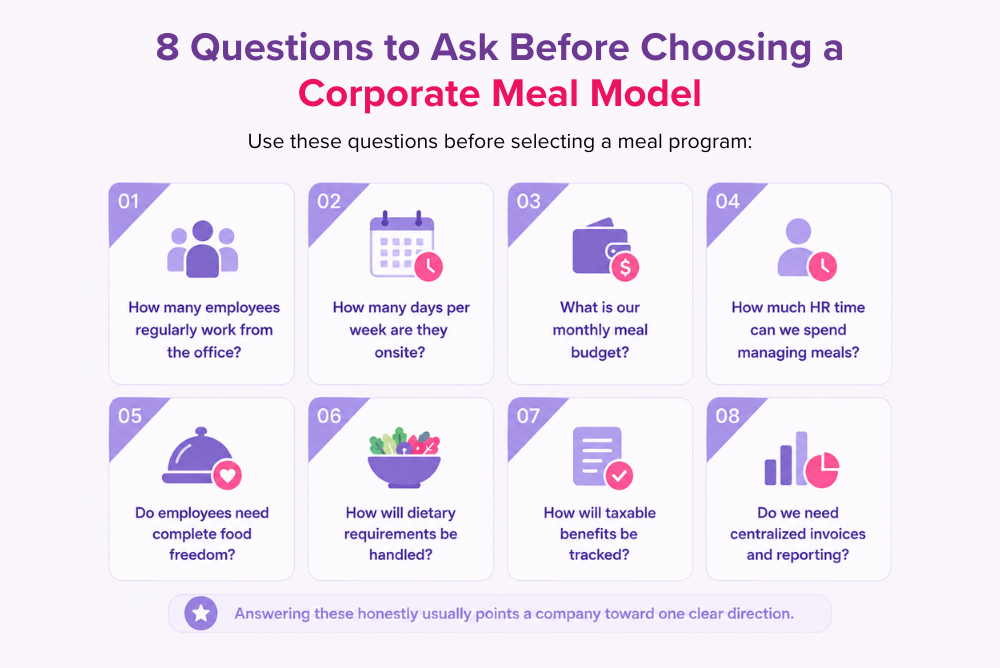
How Nüu Catering Helps Companies Control Corporate Meal Costs
Managing office lunch does not have to feel like juggling multiple vendors or coordinating endless group chats. Nüu Catering simplifies this by bringing a range of restaurant partners into a single corporate catering platform.
Here is how we help companies streamline office meal planning:
One platform, multiple restaurants: You can order from one system instead of managing multiple vendors.
Popular local options: We include Café Landwer, Mad Radish, Naan Kabob, Union Chicken, What-A-Bagel, Harvest Clean Eats and Azul.
No separate logistics: One invoice, one delivery flow, no vendor coordination.
Easy team ordering: Our system works for both small lunches and large office orders.
GTA coverage: Serves Downtown Toronto, Financial District, Liberty Village, North York, Scarborough, Etobicoke and more.
Consistent office experience: Reliable service across Bay Street, Brookfield Place, and other GTA offices.
Flexible catering: We support one-time, recurring and scheduled corporate orders.
Dietary-friendly: Easily accommodates different dietary needs without extra effort.
Final Verdict: Which Saves More?
There is no one-size-fits-all answer as it depends on how your team works. As meal stipends are perfect for remote or independent employees, managed food delivery works better for office days that give shared team experiences.
Thus, most companies end up using a hybrid model to balance convenience as well as team connection. Because it is less about the meal and more about how you want your team to experience the workday.
Want better control over your office meal program?
Talk to Nüu Catering about a managed corporate food delivery solution.
Frequently Asked Questions
Q1. Is a meal stipend taxable in Canada?
A meal allowance or reimbursement provided to an employee can be a taxable benefit. However, CRA exceptions may apply in specific situations such as certain qualifying overtime meals.
Q2. How do meal stipends work?
A company provides employees with a set amount for meals under a defined policy. Depending on the program, employees may receive the amount through payroll, reimbursement or another approved method.
Q3. How much should a Canadian company budget for employee meals in 2026?
There is no single amount that works for every company. The budget should consider employee headcount, office attendance, meal frequency, menu choices, delivery costs, taxes and the type of meal program being used.