
AI Summary
Table of Contents:
Introduction
What Causes Long Delivery Times for Toronto Office Food Orders?
Individual App Orders vs. One Coordinated Group Order
Plan Your Office Lunch Around the Delivery Window
How to Pre-Schedule to Avoid Delays
The 5 Details Every Office Order Should Include
Office Delivery Instructions Template
Failure Points That Cause Late Office Lunches and How to Prevent Them
What to Do When a Delivery Is Late
How Nüu Catering Solves This for Toronto Offices
Final Verdict
Frequently Asked Questions
| Key Takeaways Schedule larger office food orders in advance to allow enough time for preparation and delivery.Use coordinated group ordering to reduce multiple deliveries that make lunch easier to manage.Provide clear building, floor, entrance and contact details to avoid delays at the final handoff.Leave a time buffer between the expected delivery and your actual lunch or meeting start. |
Office lunch sounds simple until you have 20, 50 or 100 people waiting for their food. You place the order, everyone gets ready to eat, the meeting is about to start and then by 12:30 pm your team is hungry as the food is on the way.
If you are ordering lunch for a Toronto office, the restaurant is not the only factor that affects delivery time. Traffic, order size, preparation time, building access and the final handoff can all make a difference.
Even during Toronto’s hot summer days, waiting for lunch is the most frustrating part of the day as nobody wants food warm or losing its freshness while all are busy in the meetings. The good news is that many delivery delays are avoidable. A little planning before the order is placed can save you a lot of last-minute stress.
So, if you are wondering how to reduce office food delivery wait times in Toronto, this blog contains simple ways to make your next office lunch run more smoothly.
What Causes Long Delivery Times for Toronto Office Food Orders?
Before fixing delays, it is important to understand the root cause of the problem. There are some of the most common reasons why office food delivery takes time.
1. Last-minute ordering: A large office order takes more planning than an individual lunch. If an order is placed too close to the lunch hour, the restaurant needs more time to prepare it.
2. Large order volumes: Preparing 30 individual meals is different from preparing one lunch for one person. The restaurant needs to organize multiple meals, packaging, dietary requests and delivery items.
3. Unclear office instructions: “Deliver to reception” is not enough. A driver still needs to know which entrance to use, what floor to visit or who should receive the order.
4. Slow handoffs: Sometimes the driver reaches the building on time but the food still takes another 10–15 minutes to reach the team. That happens when nobody is ready to receive a large order.
5. Too many individual orders: If eight people order from eight different apps, you have eight kitchens and eight drivers. Lunch only arrives when the slowest order does. This also makes it harder to track missing items, changing ETAs and delivery updates.
6. Toronto traffic during lunch: Areas like the Financial District, King West, Liberty Village and North York get very busy during peak lunch hours. This can slow down deliveries. Drivers also need extra time to find parking, enter the building or reach the correct office floor.
7. Restaurants are not ready for large office orders: A café that can quickly prepare two lunches needs more time to make 40 labeled meals. Without advance notice, the kitchen struggles to manage packaging, dietary requests and order accuracy.
8. No extra time in the schedule: Ordering 20 minutes before lunch leaves no room for kitchen delays, elevators or downtown parking. Even a small delay can push the delivery past the time your team is ready to eat.
9. Late dietary changes: Asking for a gluten-free or special meal at the last minute can delay the entire order. The additional charges are applied by the restaurant for the preparation steps or confirmation of ingredient details before completing the order.
Individual App Orders vs. One Coordinated Group Order
| Factors | Individual App Orders | One Coordinated Group Order |
| Ordering process | Each employee places a separate order through an app. | Employees select their meals through one shared office order. |
| Number of deliveries | Multiple drivers arrive at different times. | One coordinated delivery arrives for the office. |
| Delivery tracking | Employees & office staff need to track several orders separately. | The office can monitor one group order and delivery status. |
| Restaurant selection | Employees can order from different restaurants & platforms. | Employees can choose from available restaurant options. |
| Delivery timing | Orders may have different preparation times and ETAs. | Meals are organized around one scheduled delivery window. |
| Building access | Multiple drivers need separate instructions for reception, elevators and office access. | Building instructions are provided once for the coordinated office delivery. |
| Employee choice | Employees have complete independence over where and what they order. | Employees can still choose different meals while ordering through one group system. |
| Best suited for | Small teams or informal lunches where employees order independently. | Corporate lunches, meetings and larger office events that require predictable delivery. |
Plan Your Office Lunch Around the Delivery Window
A common mistake is planning lunch around the time the food should arrive. Instead, plan backwards. If your team needs to start eating at 12:30 PM, the delivery should arrive early enough to allow for receiving, unpacking and setting up the food. This is useful for meetings.
For example:
12:00 PM: Food arrives
12:05 PM: Order is checked and arranged
12:15 PM: Team starts gathering
12:30 PM: Lunch begins
It also helps when the office is in a busy location such as Brookfield Place or another large downtown office building where the driver may need to navigate reception or building access. The important point is to avoid making the delivery ETA the same as your lunch start time.
How to Pre-Schedule to Avoid Delays
Knowing how to pre-schedule to avoid delays can make office lunch planning much easier. Instead of waiting until the morning of the lunch, finalize the important details earlier. You can follow this simple process:
Step 1: Confirm your headcount
Know roughly how many people will be eating.
Step 2: Choose the menu
Select restaurants as well as meal formats that work for your team.
Step 3: Collect dietary requirements
Check for vegetarian, vegan, gluten-free, halal or other requirements before the order is finalized.
| Nüu Catering provides dietary-friendly choices across its curated restaurant selection. |
Step 4: Set an employee deadline
Give employees a clear time to select their meals.
Step 5: Confirm the delivery details
Add the office address, floor, suite, entrance and contact person.
Step 6: Schedule the delivery
Choose a delivery window that gives the office enough time to receive and set up the food.
Pre-Scheduling Checklist Before confirming the order, check:
- Confirm the headcount
- Finalize the menu
- Confirm the dietary requirements
- Finalize employee meal selections
- Schedule the delivery time
- Add the building instructions
- Assign a person to receive team lunches
- Inform the team about office lunch
For recurring lunches, this process can become even easier. Nüu Catering offers recurring office meal programs for teams that want a more consistent ordering routine.
The 5 Details Every Office Order Should Include
Some delays happen after the driver reaches the building, especially when access instructions or a receiving contact are unclear. So the order must contain more than an address. By giving these 5 details, you can reduce the office food delivery wait times in Toronto.
1. Full building name and address rather than a street number
2. Company name plus floor or suite
3. Primary and backup contact number
4. Preferred handoff point such as lobby, concierge, reception or loading dock
5. Target room-ready time means the time you need food in the room
This is helpful for offices around Toronto’s Financial District and Bay Street. The clearer the instructions, the less time the driver has to spend figuring out where to go after arriving.
Office Delivery Instructions Template
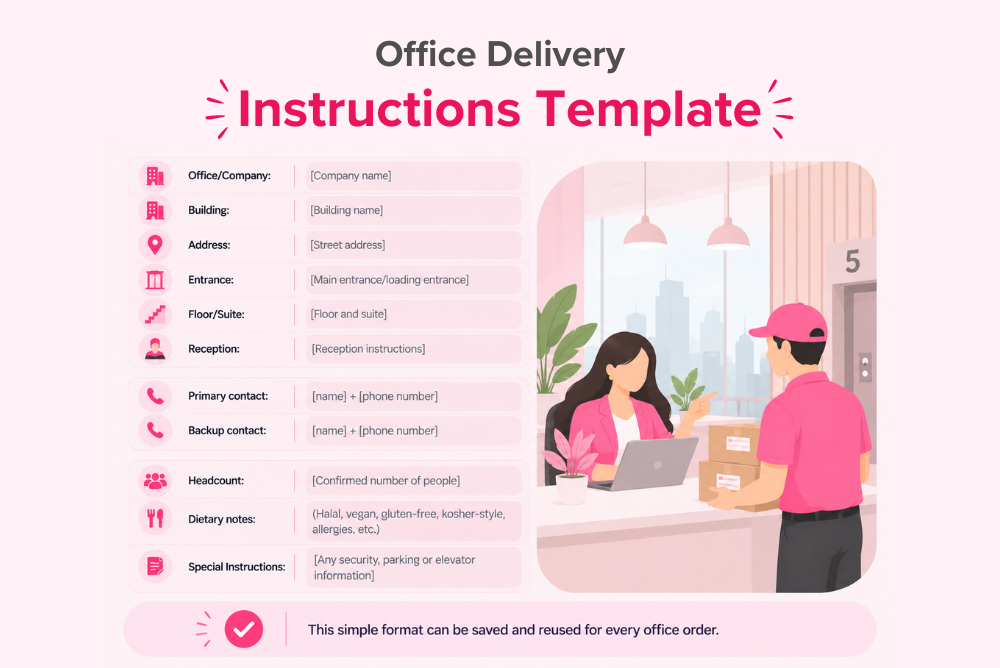
Office/Company: [Company name]
Building: [Building name]
Address: [Street address]
Entrance: [Main entrance/loading entrance]
Floor/Suite: [Floor and suite]
Reception: [Reception instructions]
Primary contact: [name] + [phone number]
Backup contact: [name] + [phone number]
Headcount: [Confirmed number of people]
Dietary notes: (Halal, vegan, gluten-free, kosher-style, allergies, etc.)
Special Instructions: [Any security, parking or elevator information]
This simple format can be saved and reused for every office order.
Failure Points That Cause Late Office Lunches and How to Prevent Them
Even with good scheduling, there are many failure points that cause late-lunch situations in Toronto office buildings. Here are some of the common ones.
1. The order is placed too late
Fix: Schedule larger orders in advance.
2. Employees keep changing their meals
Fix: Set a firm meal selection deadline.
3. The driver cannot find the office
Fix: Provide detailed building and entrance information.
4. Nobody is ready to receive the order
Fix: Assign one person to monitor the delivery and receive the food.
5. Too many individual deliveries
Fix: It is best to choose a coordinated group order.
6. The office is not prepared for a large delivery
Fix: Clear a receiving area and prepare the lunch space before the food arrives.
7. Nobody is monitoring the ETA
Fix: Track the order and act when the delivery status changes.
What to Do When a Delivery Is Late
Knowing what to do when a delivery is late is as important as knowing how to prevent one. Start by checking the latest ETA.
- If the order is being prepared, the issue may be at the restaurant.
- If it has been picked up, check the delivery status and updated arrival time.
- If the expected delivery time has passed, contact the provider rather than leaving employees guessing.
Then give your team a quick update. For example, sending a message like “The delivery is running 15 minutes late; we are tracking it.” It can prevent multiple people from contacting the office administrator.
After the delivery arrives, record what happened from the time the order was placed until delivery.
- Was it preparation time?
- Was traffic the cause of the delay?
- Is there difficulty in building access?
- Are there incorrect instructions?
- Did the office schedule the order too close to lunch?
Knowing the reason helps you improve the next order.
How Nüu Catering Solves This for Toronto Offices
Office food delivery needs a different approach for ordering lunch. Nüu is built specifically for workplace food delivery with several features that help offices manage group meals, employee preferences and delivery coordination. We provide:
- Order Together for coordinated team ordering
- Live GPS tracking for team orders
- Recurring meal scheduling
- Dedicated concierge support
- Dietary-friendly menu options
- Large group catering
- One organized group checkout
With 35+ pre-vetted restaurant partners across Toronto and the GTA including Café Landwer, Naan Kabob, Mad Radish and Freshii with service areas including Downtown Toronto, the Financial District, Liberty Village, North York, Scarborough and Etobicoke.
Final Verdict
Late office lunches in Toronto are not a food problem; they are a coordination problem. As reducing office food delivery wait times in Toronto does not get solved by finding a faster delivery driver, it starts with better planning. Consolidate the time, give proper instructions, plan everything around the lunchtime and then keep some buffer time for emergencies. In this way your team lunches can become much easier to manage.
Planning lunch for your Toronto office?
Nüu Catering makes group orders and deliveries easy.
Frequently Asked Questions
Q. Can recurring office food delivery reduce lunch delays in Toronto?
Yes, recurring office deliveries can create a consistent ordering routine by making it easier to plan headcounts, menus, delivery times and building instructions.
Q. How can I reduce office food delivery wait times in Toronto in 2026?
By scheduling larger orders ahead of time, setting employee ordering deadlines, providing detailed building instructions, coordinating meals through one group order and monitoring the delivery ETA. These steps can reduce delayed lunches.
Q. How far in advance should I schedule food delivery for a Toronto office?
The right lead time depends on the restaurant, order size, menu and delivery requirements. For larger corporate orders, planning ahead gives the restaurant and office more time to prepare.