

AI Summary
Table of Contents:
Introduction
What Should You Track on an Office Food Delivery Platform?
How to Monitor Costs Per Team and Identify Where Your Budget Goes
What Reporting Features Delivery Platforms Offer for Office Catering?
Use Employee Food Preferences to Understand More Than Just What People Like
Connect Team Spending With Employee Preferences
How to Optimize Catering Spend With Data Instead of Guesswork
Set Spending Limits Without Taking Away Employee Choice
Use Past Ordering Data to Make Better Future Decisions
Mistakes to Avoid When Tracking Office Food Spend
How Nüu Catering Helps Toronto Teams Make Office Food Ordering Easier
Final Reflections
Frequently Asked Questions
| Key Takeaways Track team spending, meal costs and employee participation to understand your office food budget better.Use employee food preferences to plan menus along with quantities and dietary options more effectively.Compare team size plus participation and average meal cost instead of looking only at total spending.Use past ordering data to optimize catering spend and make future orders more accurate.Set clear spending limits while still giving employees flexibility to choose their meals. |
What if your office food budget is increasing but you are not sure where the money is going?
Which teams are spending the most?
Are employees choosing the meals being ordered?
Are some office days costing more than others?
These questions become important for Toronto companies that order meals regularly. An office near Brookfield Place or Bay Street has very different lunch habits from a team working somewhere in the GTA.
An office food delivery platform to track spending in Toronto brings this information together in one place. Instead of checking scattered receipts and spreadsheets, office managers can review spending, ordering patterns and employee food preferences more easily.
In this blog, we will cover how to track office food spending, monitor costs by team, understand employee food preferences and use catering data to make better ordering decisions.
What Should You Track on an Office Food Delivery Platform?
The first step is to know about that information that is actually useful. Tracking only the total monthly food bill is not enough. For example, a $6,000 catering bill does not tell you whether the money was used efficiently. Thus, it is best to start by tracking:
Total food spend: How much the office spends each month.
Cost per employee: The average amount spent on participating employees.
Cost per team: How much each department or group is using.
Average order value: The typical cost of an office meal order.
Participation: How many employees actually order.
Meal preferences: Which cuisines and meal types employees select.
Dietary needs: Vegetarian, vegan, gluten-free and other requirements.
Budget variance: The difference between planned as well as actual spending.
Once you track these, you will get a clearer picture. You will notice which teams order more often and which cuisines are picked again and again. That’s the real value of an office food delivery platform that turns random lunch orders into useful data.
How to Monitor Costs Per Team and Identify Where Your Budget Goes
Big companies with multiple departments lose track of who is spending what. One team in the Financial District orders weekly lunches whereas another team near Bay Street only orders for client meetings.
Thus, knowing how to monitor costs per team can help HR and office managers understand whether their catering budget is being used evenly. Start by separating orders by department, team or budget category.
To compare teams fairly, calculate the average cost per participating employee:
Cost per participating employee = Team food spend ÷ Number of participating employees
Example: If a team spends $1,200 on lunch for 30 participating employees, its average cost is $40 per employee. Comparing this figure across teams can reveal where spending patterns differ.
For Toronto offices, this level of detail is useful when departments follow different schedules, work from multiple locations or have varying levels of in-office attendance.
What Reporting Features Delivery Platforms Offer for Office Catering?
When comparing platforms, do not focus only on the restaurant selection. Understanding what reporting features delivery platforms offer should be an important part of your evaluation. Because useful reporting features include:
- Order history
- Total spending
- Spending by team
- Average order value
- Employee participation
- Budget limits
- Invoice information
- Meal selections
- Dietary preferences
- Historical ordering patterns
- Delivery and order status
The goal is to choose a system that gives your office enough information to make better decisions.
| Want to simplify office meal planning and keep your orders organized? Explore Nüu Catering for your next Toronto team meal. |
Use Employee Food Preferences to Understand More Than Just What People Like
Food preference data is not only about finding everyone’s favourite cuisine. It tells you about culture, dietary needs and comfort. It can help you understand how your team actually uses its food budget.
Some employees need halal or kosher-style meals and others want vegan or gluten-free. Tracking employee food preferences properly means everyone feels included at the table. It also helps you avoid waste. If half your team never touches a certain dish, you will know not to order it again.
Nüu Catering includes many restaurant options such as Café Landwer, Mad Radish, Naan Kabob, Pokéworks, Mabel’s Bakery and Chop Hop that give offices different cuisines and meal styles to work with.
Connect Team Spending With Employee Preferences
Spending and preference data work best when reviewed together. Comparing team size, participation and average meal cost shows where your catering budget is going.
Employee preferences also guide future orders. Popular meals, cuisines and dietary needs help you choose those options that employees enjoy more. During hot summer days, teams prefer salads, grain bowls, wraps, fruit and smoothies. In colder months, warmer meals as well as soups are more preferable.
Preferences can also vary by department or office location. Some teams may prefer individual meals while others may choose shared platters or boxed lunches. Understanding these patterns can help reduce food waste.
Over time, this data can help you create a more accurate catering budget. The goal is not simply to spend less but to make each order more practical and relevant to your team.
How to Optimize Catering Spend With Data Instead of Guesswork
The best way to optimize catering spend with data is to use previous orders to improve future decisions. Here are some practical ways to do it:
1. Check your highest-cost orders: Look at which orders cost the most and why.
2. Compare participation: A low-participation meal needs a different ordering approach next time.
3. Review average meal cost: A small increase per meal can become significant across a large team.
4. Identify popular options: Repeat meals that employees consistently choose.
5. Review dietary demand: Use preference data to choose restaurants that can accommodate more people.
6. Adjust quantities: Use previous participation to avoid ordering more food than needed.
7. Review recurring orders: Check whether scheduled meals still match current attendance.
8. Compare teams: Look for unusual spending patterns rather than assuming every department should spend the same amount.
The objective is not always to spend less; rather, it is to spend more intentionally.
Set Spending Limits Without Taking Away Employee Choice
Budget control does not mean giving everyone the same meal every day. Employees can have individual choices while the company sets clear boundaries.
For example, an office can establish a maximum meal budget per person where employees can choose from suitable options within that limit.
This approach can work well for a group order because everyone gets some flexibility to choose based on their preferences while the organizer maintains visibility over the overall cost.
Nüu’s Order Together model is designed around this type of group ordering, where employees can make their own meal selections while the order remains coordinated as one office meal.
| Planning a team lunch in the Toronto Financial District? Let Nüu handle the coordination while your team focuses on the workday. |
Use Past Ordering Data to Make Better Future Decisions
Your previous orders can tell you a lot about your next one. Before placing a large office order, review the last few similar orders. Ask these quesitons:
- How many people ordered?
- What was the average spend?
- Which meals were popular?
- Which options were barely selected?
- Did the team stay within budget?
- Were there changes in attendance?
Nüu’s AI Smart Order feature is designed to help teams plan quantities based on various factors such as team size as well as previous ordering patterns. This type of information is useful for recurring office meals.
For example, a company with a regular Wednesday lunch can compare previous Wednesdays rather than guessing how much food to order. That makes the next order easier to plan.
Mistakes to Avoid When Tracking Office Food Spend
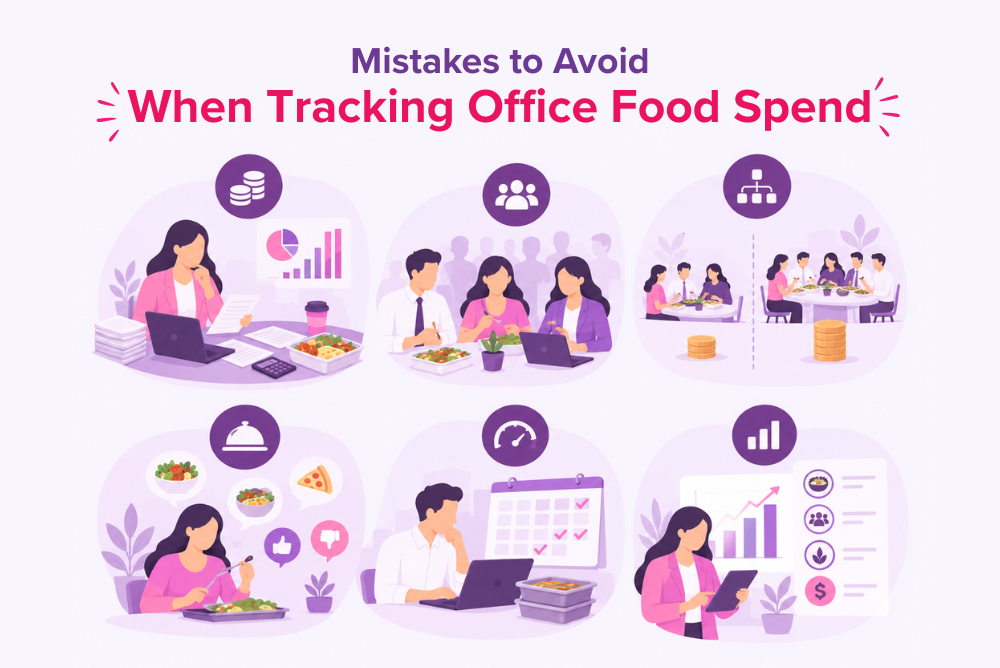
1. Tracking only the total bill
See where your budget is actually going.
2. Ignoring participation
$300 for 10 employees is different from $300 for 30.
3. Comparing teams unfairly
Consider team size before judging spending.
4. Ignoring food preferences
The cheapest meal is not useful if employees do not want it.
5. Setting unrealistic limits
Base budgets on real ordering patterns.
6. Collecting data without acting
Use reports to improve future catering decisions.
Track These Metrics
- Total spend
- Cost per employee
- Team participation
- Meal preferences
- Dietary needs
- Budget variance
Track the right data. Make better office food decisions.
How Nüu Catering Helps Toronto Teams Make Office Food Ordering Easier
Managing office meals in Toronto can involve more than choosing a restaurant. You are coordinating a meeting near Brookfield Place, arranging lunch for a team around Commerce Court or planning a recurring meal for employees across the city. Nüu brings multiple restaurant options together on one office catering platform.
We connect offices with over 35 curated restaurant partners across Toronto and the GTA, so teams get variety instead of the same three menus on repeat. Craving something fresh, you can choose Café Landwer; for a healthy bowl, you can go for Mad Radish or a quick bagel from What-A-Bagel? It is all on one platform.
We also support group ordering, scheduled meals, individual selections, live tracking and dedicated support, which means your office does not have to manage every restaurant, employee choice and delivery update separately.
Final Reflections
Tracking team spending and food preferences is not about controlling lunch choices. It is about making smarter decisions with the data you already have. The right office food delivery platform turns scattered orders into clear ones that save money and keep employees happy. Whether your office is in the Financial District, near Brookfield Place, or spread across the GTA, the tracking platform makes everything effortless.
Ready to simplify your office catering?
Get started with Nüu Catering today and bring better lunches to your team.
Frequently Asked Questions
Q. How can employee food preferences help reduce catering costs?
Employee food preferences show which meals, cuisines and dietary options are selected. Companies can use this information to plan better quantities, avoid unpopular options and choose menus that are more likely to be eaten.
Q. Can office food delivery platforms help companies stay within a catering budget in 2026?
Yes, an office food delivery platform can help companies manage budgets through their spending, order history, group ordering and price controls. Reviewing actual spending against planned budgets also helps teams make better decisions for future orders.
Q. Why is tracking employee preferences important for office catering in 2026?
Tracking preferences helps companies understand what employees truly want instead of relying on assumptions. When preference data is combined with spending and participation data, offices can plan more suitable meals while using their catering budget more effectively.