
AI Summary
Table of Contents:
Introduction
Why Office Food Delivery for Co-Working Spaces in Toronto Is Different
How Food Delivery Works in a Shared Space
What Ordering Options Suit a Hot-Desk Environment?
How Delivery Is Coordinated Without a Fixed Address
Set One Clear Delivery Point for Every Coworking Lunch
Choose Between Individual Meals and Shared Catering
Build the Order Around Changing Coworking Headcounts
Manage Different Budgets When Multiple Teams Share the Same Space
Make Dietary Preferences Easier to Manage in a Shared Workspace
Time the Delivery Around Toronto Coworking Schedules
Create a Coworking-Space Food Delivery SOP
Know When a Coworking Space Should Use a Catering Platform
How Nüu Catering Makes Office Food Delivery Easier for Toronto Co-Working Spaces
Final Reflections
Frequently Asked Questions
| Key Takeaways Plan delivery around changing coworking schedules and headcounts.Use one clear delivery point to avoid confusion.Individual meals work well for different food preferences.Shared catering is better for meetings and group lunches.Nüu offers 35+ curated restaurant partners for workplace orders. |
The lunch bell rings but no one is sitting in the same place. One team is gathered in a private office, another is spread across hot desks and a third is welcoming a client into a shared meeting room.
In a Toronto co-working space, even a simple lunch can turn into a delivery puzzle. That is why office food delivery for co-working spaces in Toronto needs more than a restaurant choice. It needs a clear plan to make everything effortless.
A simple process can make office food delivery easier to manage in a shared workspace:
- Choose one delivery point.
- Add the building, floor and suite.
- Use individual meals for varied preferences.
- Choose platters for group events.
- Label dietary meals clearly.
- Assign one person to receive the order.
In this blog, we explore how food delivery works in a shared space, how to manage office food delivery for co-working spaces in Toronto and which ordering options make hot-desk lunches easier to coordinate.
Why Office Food Delivery for Co-Working Spaces in Toronto Is Different
A regular office has one team, one floor and one delivery address. A co-working space can have several businesses under one roof. Employees move between desks during the day and meeting rooms can change. It even has rotating headcounts, mixed dietary needs and no single person in charge of lunch.
This is the reason why office food delivery for co-working spaces in Toronto needs a more organized approach. A co-working space near Bay Street orders a lunch where several companies are receiving packages, visitors are checking in and meeting rooms are in use. Then the food needs a clear destination.
| Traditional office = Fixed people + Fixed desks + One team Co-working space = Changing people + Flexible desks + Multiple teams |
How Food Delivery Works in a Shared Space
How food delivery works in a shared space depends on how well the order is planned before the driver arrives.
Start by confirming who is ordering.
Ask some questions like:
- Is it one company?
- Several teams?
- A networking group?
- Everyone attending a co-working event?
Next, decide where the food should go.
The delivery instructions should include:
- Building name
- Street address
- Floor
- Suite
- Reception details
- The name of the person receiving the order.
The ordering method also matters.
Employees can select their own meals when they have different preferences. For a smaller event, a pre-selected menu or shared platters may be easier.
| Nüu Catering allows one person to start a group order and share it with the team. Employees can then choose their own meals while the orders are combined into one delivery with individual labels and dietary tags. |
What Ordering Options Suit a Hot-Desk Environment?
Hot desks make individual meal ordering more useful. People are not necessarily sitting together. They may also have different food preferences. Here are three practical options.
Individual meals: This option is best when everyone wants something different.
Shared platters: It is better for networking events, workshops or informal team lunches.
Group ordering: This is useful when employees want individual choices but the organizer still needs one coordinated order.
One person could choose a meal from Café Landwer while another selects from Pokeworks. The important thing is to keep orders organized rather than asking everyone to place completely separate deliveries.
Nüu Catering supports both shared platters and individual boxes along with options such as halal, vegetarian, vegan, gluten-free and kosher-style meals.
How Delivery Is Coordinated Without a Fixed Address
Coworking buildings share one main entrance for several companies. A driver arriving with ten bags does not know which desk goes with which company. To fix this problem, you need to give the address in this manner. It is the sample pattern:
Building: Brookfield Place
Area: Shared office
Floor: 12
Delivery point: Reception
Recipient: Office administrator
Contact: Mobile number
Extra instruction: Call reception on arrival
This is much clearer than providing a company name alone. It helps when several companies use the same building. As the goal is to give the delivery person one clear path from the building entrance to the person responsible for receiving the order.
Set One Clear Delivery Point for Every Coworking Lunch
One delivery point makes shared-office lunches easier. So it is best to pick a single spot every single time like a meeting room, a shared kitchen or the reception desk near the elevators. The important thing is consistency.
If employees are working from different desks, the delivery should not depend on someone being at a specific workstation. This is especially useful in bigger buildings like Brookfield Place, where multiple businesses share common areas and drivers need one clear point of contact.
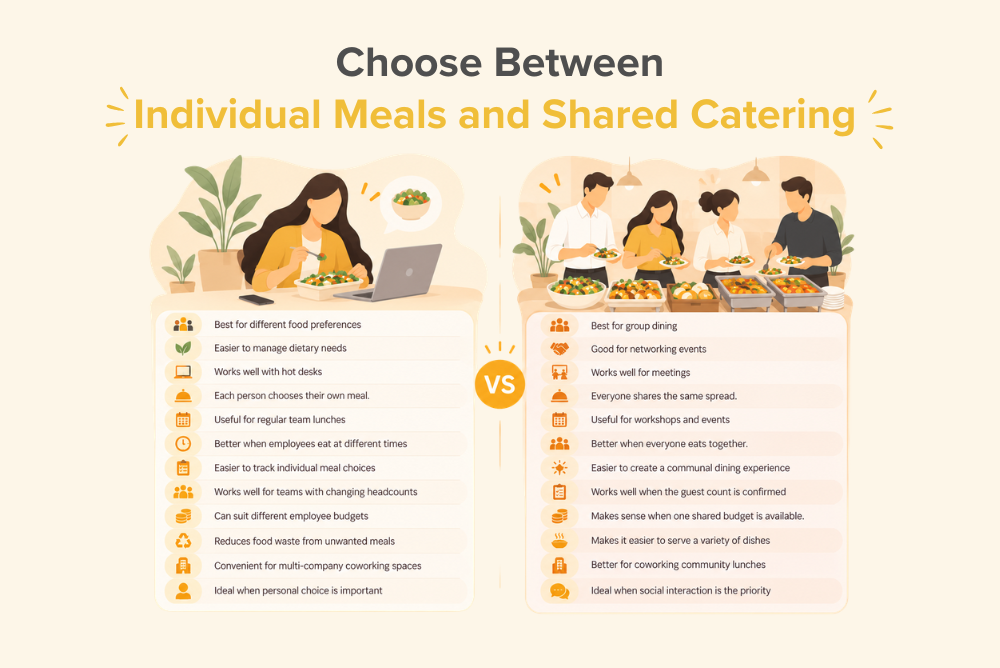
Choose Between Individual Meals and Shared Catering
| Individual Meals | Shared Catering |
| Best for different food preferences | Best for group dining |
| Easier to manage dietary needs | Good for networking events |
| Works well with hot desks | Works well for meetings |
| Each person chooses their own meal. | Everyone shares the same spread. |
| Useful for regular team lunches | Useful for workshops and events |
| Better when employees eat at different times | Better when everyone eats together. |
| Easier to track individual meal choices | Easier to create a communal dining experience |
| Works well for teams with changing headcounts | Works well when the guest count is confirmed |
| Can suit different employee budgets | Makes sense when one shared budget is available. |
| Reduces food waste from unwanted meals | Makes it easier to serve a variety of dishes |
| Convenient for multi-company coworking spaces | Better for coworking community lunches |
| Ideal when personal choice is important | Ideal when social interaction is the priority |
Build the Order Around Changing Coworking Headcounts
Co-working attendance can change quickly. Someone may work from home that day, another employee may book a desk unexpectedly and a client may join a meeting. This makes headcount one of the first things to confirm before ordering.
For recurring lunches, looking at attendance patterns is very important instead of guessing. This gives employees enough time to choose their meals and gives the organizer a more accurate final count.
Nüu’s office catering platform is designed for group orders with its Toronto service covering team lunches, large corporate gatherings and recurring meals.
Manage Different Budgets When Multiple Teams Share the Same Space
Not every company on a shared floor has the same lunch budget. One startup has a fixed amount per employee and another company covers a larger meal allowance. A co-working operator can also sponsor a community lunch. This is where budget controls can make group ordering easier.
Setting a per-person budget can solve this problem easily. Everyone picks from a menu that fits within that budget, so nobody overspends and nobody feels left out. This is one of the simplest ways to keep office food delivery fair across a mixed coworking crowd.
Make Dietary Preferences Easier to Manage in a Shared Workspace
Dietary requirements can become difficult to track when the organizer is collecting preferences through separate messages. One employee is vegetarian; another needs gluten-free food and someone else needs halal options.
Therefore, a structured ordering process makes these choices easier to manage. This matters in a shared workspace because the organizer may not know every employee’s requirements. Let people communicate their needs through the ordering process instead of relying on a spreadsheet or a long email chain.
| Want dietary tags sorted automatically? Explore Nüu Catering’s ordering platform and skip the manual spreadsheet. |
Time the Delivery Around Toronto Coworking Schedules
Lunch does not always have to arrive at exactly noon. The best delivery time depends on the team’s schedule, meeting calendar and the pace of the workday.
- A client meeting may run until 12:30 p.m.
- A workshop may continue until 1 p.m.
- Some teams may prefer an earlier lunch.
- Hot summer days in Toronto may affect food quality as well as timing.
- Building activity around Bay Street can influence the delivery handoff.
Food that arrives too early is kept as it is as people are busy in their meetings, while food that arrives too late can leave people waiting when they should be working. For a financial district office, the ideal delivery window is the one that matches the team’s actual routine and keeps lunch convenient for everyone.
Create a Coworking-Space Food Delivery SOP
A simple standard process can prevent most lunch-day confusion.
Before ordering
- Confirm the headcount.
- Set the budget.
- Collect dietary requirements.
- Choose individual meals or shared catering.
- Set an ordering deadline.
Before delivery
- Confirm the delivery address.
- Add the floor and suite.
- Choose one delivery point.
- Assign a recipient.
- Share delivery instructions with reception.
At delivery
- Confirm the order.
- Move the food to the agreed area.
- Notify employees.
- Check that special meals are clearly identified.
After lunch
- Note what worked.
- Record popular meal choices.
- Adjust the next order based on feedback.
This turns food delivery into a repeatable process instead of a new task every time lunch is planned.
Know When a Coworking Space Should Use a Catering Platform
Ordering from five different apps for five different teams is not a very convenient method. As regular food delivery apps work best for one or two people. It is not efficient when a group needs several meals.
A single platform means one invoice, one delivery window and group chats about missing spring rolls. Here are 4 signs that show it is the time to switch:
- Multiple companies keep asking who is ordering lunch today?
- Dietary requests are getting missed.
- Delivery mix-ups are becoming a regular thing.
- Nobody wants to be the designated food person anymore.
A catering platform is more useful when the order involves multiple people. The restaurant selection also gives teams variety without requiring the organizer to coordinate several separate orders.
For example, a team can consider options from What-A-Bagel, Naan Kabob, Mad Radish, Union Chicken, Tabule or Pokeworks that are all listed among Nüu’s restaurant partners.
| Have a larger coworking lunch coming up? Browse Nüu’s corporate catering options and build the order around your team’s size and preferences. |
How Nüu Catering Makes Office Food Delivery Easier for Toronto Co-Working Spaces
Nüu Catering is built around workplace food ordering in Toronto and the GTA. We bring multiple restaurant options into one place with group ordering that is designed to make office meal planning easier.
As for the co-working teams, the most useful part is the flexibility where employees can choose their own meals while the order remains centralized. We support individual boxes and shared platters, depending on the type of office occasion.
We cover areas like Downtown Toronto, the Financial District, Liberty Village, North York, Scarborough, Etobicoke and other GTA business hubs. Each order is split into individually labeled boxes that suit hot-desk environments perfectly. Dietary tags including halal, vegan and gluten-free, are done accurately so that nobody can get confused over their team lunches.
Final Reflections
Feeding a coworking space is not the same as feeding a single office. It needs a lot of planning, a clear delivery point and a system that can manage changing headcounts. Once that structure is in place, office food delivery does not feel like a weekly headache. It becomes something that people look forward to.
Not sure where to start?
Talk to the Nüu Catering team about setting up recurring lunches for your shared office.
Frequently Asked Questions
Q. How does office food delivery work in a Toronto coworking space in 2026?
Office food delivery for a Toronto coworking space involves choosing an ordering method, collecting meal preferences, setting a central delivery point and assigning someone to receive the order. As it makes the process easier when several employees need different meals.
Q. Can multiple companies in the same co-working space order food together?
Yes, multiple companies can coordinate a shared order when they have a clear delivery point with a central way to manage budgets & billing. Individual meal selection can also help employees choose food based on their own preferences.
Q. How can co-working spaces organize recurring offices?
Start with a regular lunch day, expected headcount, spending limit and ordering deadline. A recurring ordering process can then be adjusted based on attendance, employee preferences and feedback from previous lunches.