Introduction
Workplace meals are changing, and sustainability is one of the big reasons for this change. Earlier office meals were mainly about helping the team stay focused and productive by ensuring they ate lunch on time. But now the whole scenario has changed as companies expand their corporate sustainability initiatives for their everyday decisions.
Office meals being convenient & cost-effective has now shifted the attention of the company towards where the ingredients are coming from or how meals are packaged along with what to do with the leftovers. From thoughtful planning to smarter workplace dining initiatives, sustainable corporate solutions are evolving with time.
What are corporate sustainability initiatives in catering?
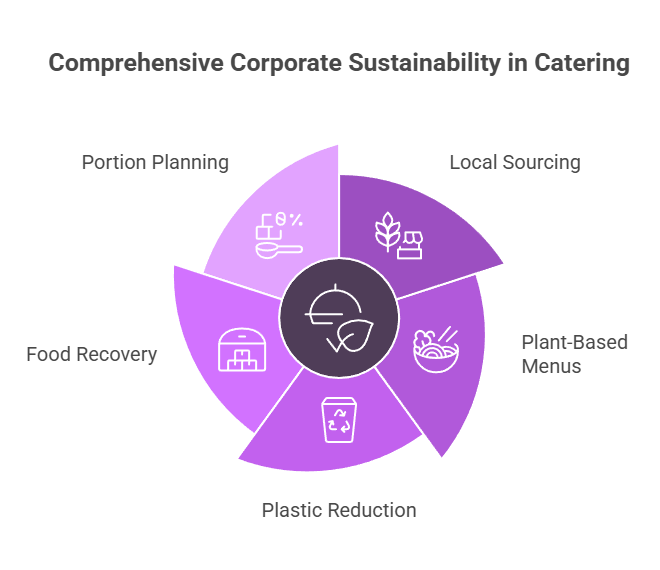
Corporate sustainability initiatives in catering mean building structured food programs that reduce environmental impact while being ethical as well as socially responsible. This includes choosing locally made ingredients with menus that are plant-based and reducing single-use plastic for packaging. Many companies are also adopting food recovery initiatives to donate surplus food and reduce landfills of those leftovers. Sustainable catering solutions come to the rescue that contain better portion planning to prevent overproduction.
Why Corporate Sustainability Initiatives Now Include Food Programs
1. Food Impacts Carbon Footprint
Workplace meals contribute to the company’s environmental footprint through sourcing with delivery and disposal. By improving food programs, businesses can cut down on waste and can lower the overall carbon footprint in a measurable way.
2. Growing ESG Reporting Requirements
Many organizations are now working towards a net-zero emissions approach that aligns their strategies with sustainable development goals (SDG) 12 & 13. Because of these catering programs, ESG reporting now became part of adapting these solutions.
3. Employee Expectations Have Shifted
Today’s workforce is taking the environment as their responsibility. With eco-friendly catering, corporates show that sustainability is not just a promise; rather, it is a matter of practice.
4. Food Waste Is a Visible Issue
Large orders lead to food waste during meetings and events. With structured food recovery initiatives, it helps to reduce landfill impact and support local communities through responsible redistribution.
5. Brand Reputation and Transparency
Clients and business partners are now paying attention to how responsible your company is towards sustainable practices. Sustainable food programs can help in building trust in the brand.
6. Cost Efficiency Through Waste Reduction
Smarter portion control & biodegradable plus reusable packaging reduces the unnecessary spending on disposing of your waste. This is not only a cost-effective solution but also reduces wastage in an appropriate manner.
What Makes Corporate Meals Truly Eco-Friendly in 2026?
In 2026, corporate meals are considered eco-friendly when sustainability is incorporated into every step of the process. It begins with meaningful sourcing, which means choosing ingredients wisely as well as working with those suppliers who follow responsible farming practices.
After that, planning a menu that has a choice of plant-based meals to reduce the environmental impact without compromising the quality of the food. With this smart planning, such as accurate headcount or portion control, it helps in preventing unnecessary waste.
Even packaging has shifted towards compostable options. This way, many companies now track their food wastage data to improve their performance with time. Along with this, delivery routes are optimized to reduce emissions and improve efficiency.
These changes all together contribute to eco-friendly catering that is more accountable as well as a sustainable system.
The Role of Food Recovery Initiatives in Modern Offices
Food recovery initiatives are now becoming an essential part of sustainable workplace dining. Instead of surplus meals going to waste after any meeting, event, or celebration, companies are developing structured processes to manage surplus food. Rather than throwing them out, they give untouched food to nonprofit or community organizations that support needy people in place of filling landfills. Modern offices are working in a practical manner for handling excess food, i.e., from proper storage to timely redistribution. These initiatives help businesses to track waste more efficiently so that they can improve their future planning as well.
How Sustainable Catering Solutions Reduce Corporate Carbon Footprint
- Digitalizing the ordering system to prevent over-ordering or last-minute waste.
- Measure food waste to improve future planning.
- Use energy-efficient kitchen equipment to lower overall consumption.
- Track carbon data from your food programs to make your planning better.
- Instead of individually packed meals, there is the shift towards bulk packaging.
- Consolidate meal deliveries to reduce travel time and follow short routes.
- By shortening supply chains plus reducing the transportation cost.
Employee Expectations Are Driving Eco-Friendly Catering
Workplace culture has changed, and employees are aware of their choices that align with a sustainable environment. They have started noticing every little default practice, like when food is wasted or excessive packaging is used. These things tend to make their catering decisions more meaningful as well as effortless. Choosing eco-friendly catering helps companies to maintain a balance between their sustainability goals and their actions. This not only encourages team responsibility but also uplifts the unity among the departments.
How Nüu Catering Supports Corporate Sustainability Initiatives
At Nüu Catering, sustainability is integrated from the very beginning of the planning process itself. Our meal programs are made in a way that can reduce the problem of wastage or overproduction. Our team focuses on structured planning with responsible sourcing that makes your corporate catering a wonderful experience. By maintaining the quality and supporting sustainable practices, we can be your reliable partner when it comes to sustainable catering solutions. With clear coordination & communication along with proper portion control, we make sure that your office lunches go smoothly while aligning with your sustainability goals.
Closing Thoughts
Corporate meals are no longer the matter of eating in the way they used to be. They are becoming part of the larger corporate sustainability initiatives that make it clear how businesses should take care of sustainable eating. Companies that invest in sustainable catering solutions that not only reduce the environmental loss but also strengthen the workplace culture.
Make your corporate sustainability initiatives count when it comes to everyday decisions at the table. Partnering with Nüu Catering helps you to create smart, eco-friendly catering solutions for your workplace.
FAQs about The Rise of Eco-Friendly Corporate Meals
How do food recovery initiatives reduce waste?
It reduces the waste by donating that surplus food to the needy people as well as including digital platforms to redistribute that leftover food to prevent throwing.
Is eco-friendly catering more expensive?
Yes, it can be more expensive, as it includes organic ingredients, which have less production as compared to others. It even needs sustainable packaging as well as skilled labor to manage all these.
What are the corporate sustainability trends in 2026?
The corporate sustainability trends in 2026 focus on net zero commitments, waste reduction, transparent ESG, and integrating sustainable practices into everyday working.