
AI Summary
Table of Contents:
Introduction
1. What Services Are Included in the Corporate Catering Contract in Toronto
2. Define Order Volumes, Scheduling Rules and Service Availability
3. Lock in Pricing Terms Before Hidden Charges Appear
4. Build Menu Flexibility and Dietary Requirements Into the Agreement
5. What Terms to Negotiate Before Signing a Corporate Catering Contract
6. What SLAs Caterers Should Commit To (Service Level Agreements)
7. Clarify Food Safety, Insurance and Compliance Requirements
8. Create Clear Policies for Last-Minute Changes and Cancellations
9. Protect Your Business With Contract Renewal and Exit Clauses
10. Know How to Exit a Catering Contract if Unhappy
Red Flags Toronto Buyers Should Never Ignore
How Nüu Catering Supports Corporate Catering Contracts for Toronto Offices
Summing Up
FAQs on Corporate Catering Contract in Toronto
Signing a catering agreement feels simple at first, where you choose a menu, confirm dates and expect food to arrive on time.
But when offices order regularly, small contract details quickly turn to a huge problem that is late deliveries, hidden charges, limited menu changes and unclear cancellation policies.
That is why having a clear corporate catering contract for Toronto offices is important.
Whether your office is near the Toronto Financial District, Bay Street, Brookfield Place or across Downtown Toronto, the right contract helps in protecting both employee experience and company budgets.
As Toronto’s hot summer days are here many offices are increasing team lunches, workplace events and recurring catering schedules to keep employees engaged.
This blog helps you to know about corporate catering contracts in Toronto in 2026. From what to include, what to negotiate to and how to exit if things go wrong.
1. What Services Are Included in the Corporate Catering Contract in Toronto
Before reviewing pricing directly, it is best to define what service you are buying. As many contracts mention catering but do not explain what is included.
A good corporate catering contract in Toronto should cover:
- Is delivery included?
- Is setup included?
- Does cleanup happen after service?
- Are serving staff available?
- Can meals be ordered for recurring office schedules?
- Are multiple office locations supported?
If your office operates from areas like Liberty Village or North York and organizes regular meetings, then these details matter.
A good contract should also explain whether catering is
- One-time event catering
- Weekly office lunches
- Executive meeting catering
- Employee onboarding meals
- Multi-location office ordering
Before signing any agreement, ask your caterer for a written breakdown of services included in every order.
2. Define Order Volumes, Scheduling Rules and Service Availability
Office catering changes very often. Therefore, a contract should be flexible enough to support growth. As one month you may order lunch for 20 employee and the next month that could become 150.
So, it is very important to ask these questions upfront:
- What is the minimum headcount per order?
- Can you scale up for large events on short notice?
- What days and hours are available for delivery?
- Is there a lead time required for orders?
- Can recurring schedules be adjusted?
- Can additional orders be added?
- Is weekend catering available?
This becomes important during summer events and company gatherings. If your office serves hybrid teams, include flexibility for changing employee counts. These small details create a better long-term catering experience.
3. Lock in Pricing Terms Before Hidden Charges Appear
Pricing surprises are one of the biggest complaints in office catering services. A contract may look affordable at first, but then delivery fees, service costs and additional charges appear later.
Your corporate catering contract for Toronto teams should clearly outline:
- Per-person pricing
- Delivery fees
- Setup charges
- Staffing fees
- Equipment costs
- Taxes
- Rush order fees
- Holiday pricing
- Minimum spend requirements
Key Takeaway: Avoid contracts that allow the caterer to adjust pricing without notice. Ask for a price lock period for at least 6 to 12 months if you are planning for recurring weekly or biweekly meals.
| Ready to get started with clear and no-surprise pricing? Book a demo with Nüu Catering today. |
4. Build Menu Flexibility and Dietary Requirements Into the Agreement
Food preferences have changed. Today’s workplace catering needs more flexibility than ever. Teams include people who have different dietary requirements like halal, vegan, gluten-free, vegetarian and kosher dietary needs.
Your catering contract should require:
- A rotating/seasonal menu to avoid repetition
- Clear labelling for allergens as well as dietary preferences
- Certified halal options where required
- Vegan & gluten-free choices every time
- The ability to request custom menus for special occasions
Restaurants available through Nüu Catering, such as What A Bagel, Café Landwer, Mevame, Lambretta Pizzeria, Freshii, Mad Radish and Azul, help offices to bring more variety into workplace meals.
5. What Terms to Negotiate Before Signing a Corporate Catering Contract
Many buyers only negotiate on pricing, but price is not always the only biggest issue. When reviewing what terms to negotiate, focus on areas that affect daily operations.
Negotiate these contract terms, such as
Service Terms
Delivery guarantees: Will food arrive on time every time?
Dedicated support contact: Who will help if something goes wrong?
Escalation process: Who handles urgent issues quickly?
Service recovery plans: What happens if service expectations are missed?
Commercial Terms
Volume discounts: Can you get better pricing for larger orders?
Recurring order incentives: Are there benefits for regular catering?
Multi-office support: Can catering be managed across different office locations?
Menu Terms
Menu rotation: Will meals be different every time?
Dietary flexibility: Can it support different food preferences and dietary needs?
Seasonal updates: Will menus be seasonally updated throughout the year?
Performance Terms
Review meetings: Will service quality be reviewed regularly?
Reporting requirements: How will catering performance be tracked?
Service feedback process: Is there a process to collect & improve based on feedback?
6. What SLAs Caterers Should Commit To (Service Level Agreements)
An SLA is a written commitment of the level of service you will receive. Every serious corporate catering company in Toronto should put SLAs in your contract.
It is best to look for commitments on:
- On-time delivery like within a 15-minute window
- Order accuracy means 98% accuracy on items delivered
- Communication such as live updates through SMS or email for every order
- Issue resolution time that address complaints within 2 hours
- Backup plans if a restaurant partner is unavailable
Real-time tracking is truly a game-changer for busy admins. When you are coordinating a lunch for 50 people at a Brookfield Place boardroom, it is beneficial to know that your food is on its way. It should not be a matter of guesswork.
7. Clarify Food Safety, Insurance and Compliance Requirements
Food quality is important in corporate catering. Food safety is non-negotiable. Every contract should explain how food is prepared, delivered and managed.
A corporate catering contract should include details such as
- Food handling procedures
- Delivery standards
- Packaging requirements
- Temperature management
- Allergy communication process
- Incident reporting procedures
- Compliance with Toronto Public Health guidelines
This matters more during Toronto’s warmer summer months when meal freshness and transportation conditions become important.
8. Create Clear Policies for Last-Minute Changes and Cancellations
Office schedules change constantly such as plans changing, team size shifting and meetings getting moved. Your contract needs a clear cancellation as well as change policy that works in your favour.
Important questions to include:
- How late can guest counts change?
- Can orders be adjusted on the same day?
- Are cancellations refundable?
- Are delivery times flexible?
- Is there a deadline for menu changes?
- Can delivery locations be updated after booking?
- Are emergency order requests accepted?
Example: If a team lunch planned near the Toronto Financial District suddenly moves to another office location, your agreement should explain how changes are handled. Strong cancellation policies reduce the stress for both sides.
| Looking for a catering partner that supports flexible workplace ordering across Toronto? Explore Nüu Catering’s office catering solutions designed for modern teams. |
9. Protect Your Business With Contract Renewal and Exit Clauses
Many companies focus on starting the contract. It is advised to think about what happens later because renewal terms deserve attention.
Review:
- Contract length
- Auto-renewal conditions
- Notice periods
- Price review timelines
- Service review dates
You should also define performance expectations before renewals happen.
10. Know How to Exit a Catering Contract if Unhappy
Before signing any agreement, make sure there is a clear process for ending the partnership if things do not work out. As many businesses focus on starting the contract but forget to plan for unexpected situations later.
Your contract should explain what happens if service quality drops plus business needs change or expectations are not being met.
Review these exit-related terms carefully:
- Required notice periods before cancellation
- Performance-based termination rights
- SLA breach conditions
- Refund or credit policies
- Service failure protections
- Transition support for moving to another provider
A clear exit clause protects your business and makes it easier to switch if the catering service does not meet your needs.
Red Flags Toronto Buyers Should Never Ignore
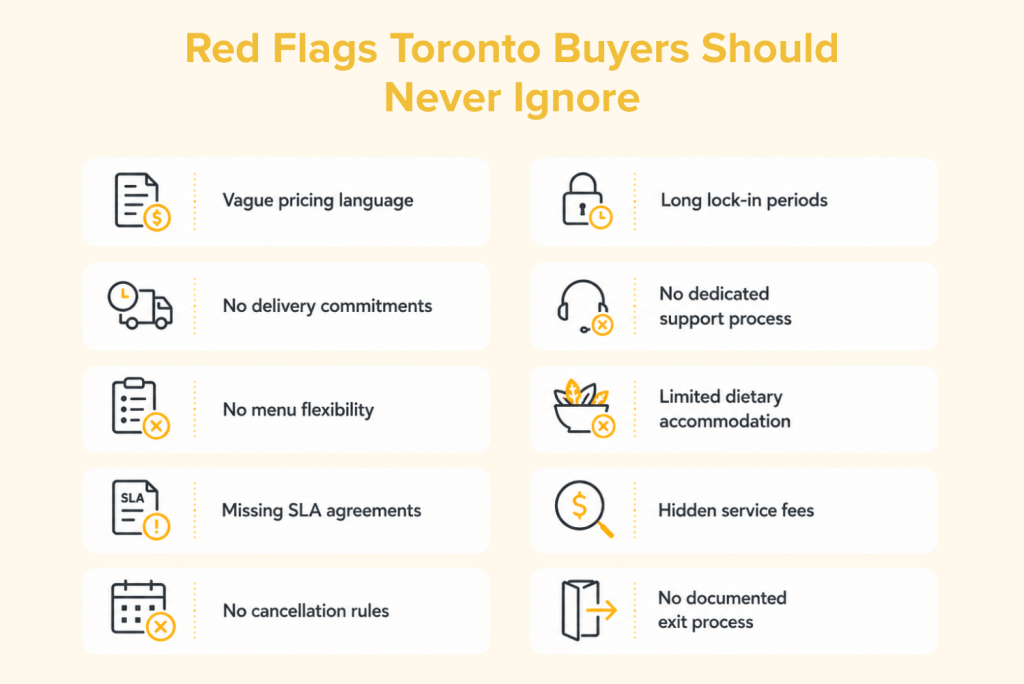
- Vague pricing language
- No delivery commitments
- No menu flexibility
- Missing SLA agreements
- No cancellation rules
- Long lock-in periods
- No dedicated support process
- Limited dietary accommodation
- Hidden service fees
- No documented exit process
How Nüu Catering Supports Corporate Catering Contracts for Toronto Offices
If you are looking for a corporate catering service in Toronto that keeps office ordering simple, Nüu Catering is a perfect choice for modern workplace needs.
Trusted by companies and institutions like Deloitte, Accenture, BMO and Sun Life. We serve offices across Downtown Toronto, the Financial District, Liberty Village, North York, Scarborough, Etobicoke and the GTA.
- 35+ restaurant partners across Toronto
- Options from restaurants like What-A-Bagel, Mad Radish, Café Landwer, Freshii and Pokeworks
- Clear pricing with no hidden charges
- Dietary-friendly menus including halal, vegan and gluten-free options
- Easy group ordering with one invoice and one delivery
- Real-time order updates
Summing Up
The best catering partnerships begin before the first meal arrives.
A solid corporate catering contract in Toronto protects your team, your budget and your time. It depends on how one should define services, pricing, menu expectations, SLAs, flexibility and exit options from the beginning.
The goal is simple meaning great food delivery that is always on time with no surprises.
Explore how Nüu Catering helps your office build a more flexible as well as scalable catering program.
FAQs on Corporate Catering Contract in Toronto
1. What does an event checklist include?
An event checklist includes guest count, catering requirements, delivery timing, menu approvals, dietary needs, staffing, setup plans and post-event follow-up.
2. What things are included in catering in 2026?
Catering in 2026 consists of:
- Food preparation
- Deliveries
- Setups
- Dietary accommodations
- Packaging
- Ordering support
- Menu customization
- Flexible scheduling options.
3. What are common catering supply mistakes?
Common mistakes include unclear order quantities with ignored dietary needs as well as late scheduling. Even missing backup plans and not confirming delivery details in advance are also the bigger mistakes.