

AI Summary
Table of Contents:
Introduction
Corporate Catering Annual Budget Planning for Toronto Offices: Where to Begin
Calculate Your Total Annual Catering Budget in 5 Simple Steps
How to Plan a 12-Month Catering Budget Without Overspending
What Occasions Should Be Included in Your Catering Budget?
Add a Buffer Budget for Unexpected Requests and Last-Minute Events
How to Track Catering Spend by Department for Better Budget Control
Use Monthly Reporting to Keep Your Annual Catering Budget on Track
Review and Optimize Your Corporate Catering Budget Every Quarter
Why Toronto HR Teams Choose Nüu Catering for Annual Corporate Catering Planning
Final Thoughts
Frequently Asked Questions
Planning office meals sounds simple until it is not your responsibility.
One month it is onboarding lunches; the next month it is a client meeting and then summer team events, executive meetings as well as appreciation lunches appear on the calendar.
For HR teams and office managers across Toronto offices, catering costs and planning becomes difficult to manage if there is no clear system for offices that are located in Toronto Financial District, Bay Street, Brookfield Place and across the GTA
This all becomes more difficult when Toronto is in its peak summer months; start looking for lighter lunch options, recurring office meals and flexible ordering schedules.
This blog explains corporate catering annual budget planning for Toronto teams that can be used throughout the full year. You will know:
- Where to begin annual catering planning
- How to calculate a yearly catering budget
- How to plan a 12-month catering budget
- What occasions to budget for
- How to track catering spend by department
Corporate Catering Annual Budget Planning for Toronto Offices: Where to Begin
Before setting a number, it is very important to decide your catering budget. Many companies make budgets based on their previous spending. A better approach for budgeting should be based on company goals.
Ask yourself these questions before setting your annual catering budget:
- Are you hiring this year?
- Are more employees returning to the office?
- Are you planning quarterly team events?
- Will client meetings increase?
- Are there seasonal office celebrations?
Key Takeaway: If your office operates around Commerce Court or the PATH network in downtown Toronto, recurring office lunches become easier to predict because of their attendance patterns that are consistent.
Calculate Your Total Annual Catering Budget in 5 Simple Steps
Before you plan anything, you need a number to start with. Here is how you reach there:
Step 1: Count Your People
Estimate how many employees eat office meals instead of using total headcount. It is better to build your budget around actual attendance to make yearly catering costs more accurate.
Example: 150 employees × 70% attendance = 105 meals
Step 2: List Recurring Events
Include regular occasions as these are easier to budget. Some of the recurring events are:
- Team lunches
- Monthly meetings
- Quarterly reviews
- Employee events
- Leadership meetings
Step 3: Estimate Cost Per Person
Choose a realistic number that fits perfectly in your office. Thus, set an average meal budget based on the following:
- Meal style
- Group size
- Restaurant choice
- Delivery setup
Step 4: Add one-off events.
Client presentations, new hire welcome lunches, product launches and many other events are those that occur throughout the year. So it is important to use estimates instead of exact numbers.
Estimated Annual Catering Budget = Average Cost per Event × No. of Planned Events
Example: $500 × 24 events = $12,000 annually
Step 5: Calculate Your Annual Budget
Add recurring & one-off costs together. Then review and adjust everything based on your budget. This becomes the starting point for your corporate catering annual budget planning for Toronto offices.
Gist: Once you have that number, you can plan properly.
How to Plan a 12-Month Catering Budget Without Overspending
This is where most companies lose control. Monthly budgeting works better than annual guesswork. If your goal is to understand how to plan a 12-month catering budget, divide your spending into four quarters.
Q1 (January–March) is quieter. Teams return after the holidays and budgets are approved; that makes it a suitable time to set catering spending limits.
Q2 (April–June) brings more activity. As Toronto’s hot summer days arrive, offices plan more lunches, meetings and events. So budget for more frequent orders.
Q3 (July–September) can vary. Vacations may reduce attendance but client meetings and internal events are continued. So keep some flexibility for this quarter.
Q4 (October–December) is the busiest period. Holiday lunches and year-end celebrations increase, so reserve a larger portion of your budget.
Planning this at the start of the year helps you avoid overspending in one month and cutting costs in another.
What Occasions Should Be Included in Your Catering Budget?
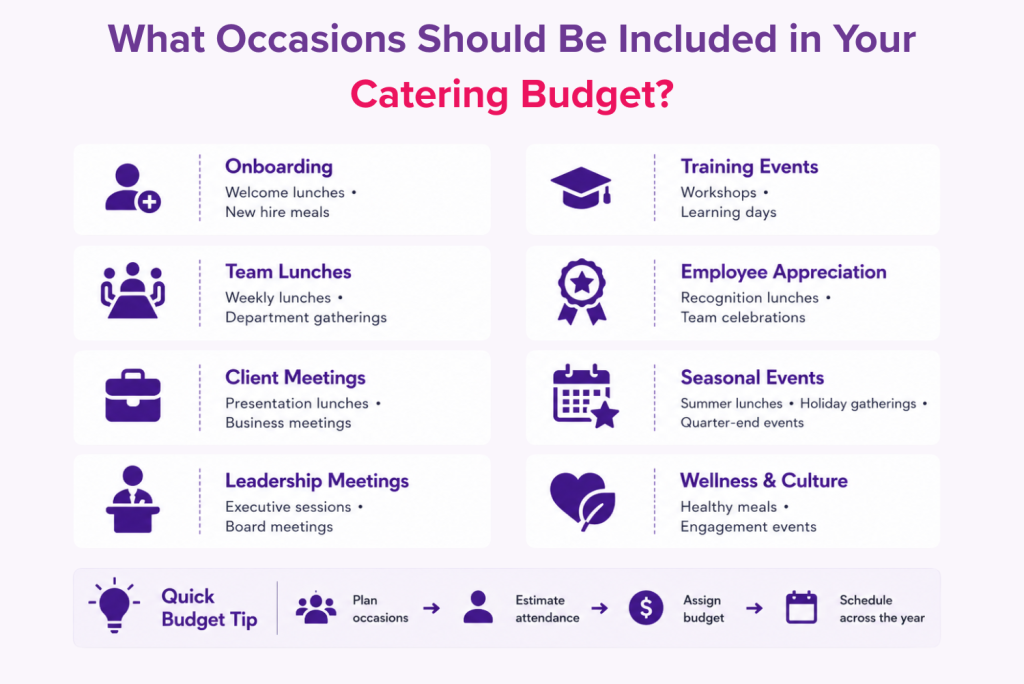
Onboarding
Welcome lunches • New hire meals
Team Lunches
Weekly lunches • Department gatherings
Client Meetings
Presentation lunches • Business meetings
Leadership Meetings
Executive sessions • Board meetings
Training Events
Workshops • Learning days
Employee Appreciation
Recognition lunches • Team celebrations
Seasonal Events
Summer lunches • Holiday gatherings • Quarter-end events
Wellness & Culture
Healthy meals • Engagement events
Quick Budget Tip
Plan occasions → estimate attendance → assign budget → schedule across the year.
Add a Buffer Budget for Unexpected Requests and Last-Minute Events
Unexpected events happen even after your careful planning. Situations like client meetings appear, hiring increases and an office event is added last minute. This is the reason why your annual catering budget should include a buffer too.
Therefore, a simple rule is to
- Use 80–90% for planned events
- Keep 10–20% flexible
This reserve helps in covering urgent meetings, onboarding, employee events and seasonal changes. As during Toronto summers, when office schedules shift more, a buffer helps you in spending under control.
How to Track Catering Spend by Department for Better Budget Control
One reason catering budgets go off track is expenses get grouped together, which makes everything very difficult. So you can divide spending by department, which makes reporting easier as well as improves accountability.
If you are wondering how to track catering spend by department, start with these categories:
| HR | Onboarding, employee engagement, recognition |
| Sales | Client meetings, presentations, team lunches |
| Marketing | Campaign launches, workshops, event support |
| Leadership | Executive meetings and strategic planning |
| Operations | Training sessions and operational events |
Centralized ordering and reporting like this make department-level budgeting much easier to manage throughout the year.
Use Monthly Reporting to Keep Your Annual Catering Budget on Track
Creating the budget is only the first step. What really keeps spending under control is checking in regularly. A quick monthly review can help you to spot those patterns that create difficulty so that you can avoid surprises later in the year.
For this, you do not need anything complicated; just set aside one time each month to review your catering performance and focus on these points that show
1. Total Monthly Spend: Did your actual catering costs stay close to what you planned?
2. Cost Per Employee: How much did each meal cost based on the number of employees who attended?
3. Event Utilization: Were meals ordered in the right quantity or was there extra food left?
4. Repeat Ordering Patterns: Which types of events stay within budget consistently?
5. Food Waste Trends: Are ordering amounts matching real attendance levels?
Nüu Catering provides one invoice per order, which makes monthly reporting much easier. Order now and keep your records clean.
Review and Optimize Your Corporate Catering Budget Every Quarter
A quarterly review goes one level deeper than monthly check-ins. Every three months, look at your catering spend across all departments and ask the bigger questions:
- Which events had the highest attendance?
- Which departments overspent?
- Were portions accurate?
- Did employees engage with the menus?
- Which months required buffer spending?
- Are there vendors consistently performing better on price and quality?
- Should we renegotiate anything for next quarter?
This is also the right time to look at what your team truly enjoyed eating. If your team loved the build-your-own bowls from Mad Radish or the fresh lunch boxes from Harvest Clean Eats, order those again. If something did not land well, swap them.
Why Toronto HR Teams Choose Nüu Catering for Annual Corporate Catering Planning
Managing office catering for a year takes time, whereas coordinating with multiple vendors takes even more time. That is why many Toronto workplaces look for a more centralized approach. Here, the right catering partner makes a big difference.
Nüu Catering is Toronto’s office catering platform that is built specifically for HR teams, office managers and executive assistants. It connects your office to over 35 curated restaurant partners across the city. From Downtown Toronto and the Financial District to Liberty Village, North York, Scarborough and Etobicoke.
On the menu side, your team can choose from various Toronto restaurants like What a Bagel, Osmow’s Shawarma, Mad Radish or Naan Kabob when you want something warm and filling. There are also Union Chicken, Freshii, Lambretta Pizzeria and Pokeworks, which are all available through one single platform.
Final Thoughts
Managing a corporate catering budget for a year does not need to be complicated. With annual planning, Toronto HR teams can control costs, reduce last-minute orders and create a better employee experience. For Toronto HR teams, whether you are running a busy Bay Street office or coordinating meals for a North York business hub, having the right catering partner matters as much as having the right budget.
Start planning smarter. Visit Nüu Catering and see what is on the menu for your team.
Frequently Asked Questions
Q. Is it better to use one corporate catering partner throughout the year?
Working with one coordinated catering partner can reduce admin time, simplify reporting and create more predictable budgeting while still offering menu variety.
Q. How can companies reduce office catering costs without lowering food quality?
Estimate attendance more accurately, standardize event spending levels, review monthly reports and plan recurring orders instead of placing last-minute requests.
Q. What metrics should HR teams track to measure catering ROI in 2026?
Track cost per employee, event participation, budget variance, food waste, department spending and employee satisfaction to understand overall value.