
AI Summary
Introduction
Planning a team lunch sounds simple—until you’re the one responsible for making it happen.
Once you’re organizing food for 20, 50, or even 200 people, it’s no longer just about placing an order. You’re juggling dietary preferences, food amounts for large groups, delivery timing, budgets, and expectations—all while trying to avoid complaints, shortages, or wasted food.
Ordering lunch for a small team is manageable. Planning catering for large groups is not.
One of the most common questions we hear from Toronto office managers and HR teams is:
“How much food do we actually need for 100 people?”
This guide breaks everything down—from choosing the right format to calculating portions and avoiding common mistakes—so your next team lunch runs smoothly, on time, and stress-free.
Why Do Team Lunches Matter at Work?
In busy Toronto offices packed with meetings, deadlines, and hybrid schedules, team lunches create a rare pause in the day.
They’re not just about eating—they’re about connection.
When teams sit down together, hierarchies soften. Conversations become more natural. New hires feel included faster. Cross-team relationships form without forcing “team-building exercises.”
Over time, these moments build trust, improve communication, and create a more relaxed, productive workplace culture.
How Do Team Lunches Benefit the Workplace?
| Benefits | Description |
| Stronger Team Bonding | Sharing meals or organizing team lunches has only one purpose: to increase team bonding. This gives a relaxed space for the employees to talk about anything beyond work. |
| Higher Engagement | Good food improves mood and focus and reduces that afternoon slump |
| Increases productivity | Employees will be productive when they eat properly. When the large group meal planning is perfect, they will eat their favorite foods, which will increase productivity by making them energetic. |
| Make employees feel valued | Providing a team lunch shows that the company cares about its employees’ well-being. They feel appreciated, which leads to higher morale and job satisfaction. |
| Improve conversations | When employees talk to each other informally, the communication barriers are reduced. With the breaking of this barrier, it becomes easy to collaborate with anyone, anytime. |
| Build cross-team interactions | Lunch brings people together who don’t work closely day-to-day |
Planning a Team Lunch: What You Need to Know
Large group meal planning goes far beyond “What should we order?”
You need to think about scale, timing, preferences, portions, and logistics. From catering for large groups to food amounts for large groups, you need a complete guide.
1. Understanding Team Size
Team size is a major aspect to keep in mind while ordering food. From the quantity of the food to serving the food, it affects everything. Planning for 20 people and planning for 200 people are completely different. It is important to always update the team size before ordering the meals, as a small mismatch can lead to food shortage or food wastage. How much food for 100 people or beyond 100? It is the most important question that arises here.
Team size impacts everything, from how much food you need to how it should be served.
Planning lunch for 20 people is very different from planning for 200. Even small miscounts can lead to food shortages or unnecessary waste.
Before placing any order:
- Confirm attendance
- Account for last-minute no-shows or extras
- Decide whether lunch is optional or mandatory
This is where questions like how much food for 100 people become critical.
2. Deciding the Lunch Format as Per the Group.
The lunch format must match the group size and office setup. Smaller teams can go for plated or boxed meals, while larger groups can go for buffet-style arrangements. The major concern is the serving flow. The food should be served equally and in a proper manner. These 3 formats are described below:
- Buffet meals allow flexible portions and are best for catering to large groups.
- Bowled meals go well when the team is limited and manageable.
- Plated meals are best for client meetings or conference meals to be convenient.
Therefore, choosing the right lunch format will save your team from overcrowding.
The format should match your group size and office setup.
Common formats for catering for large groups:
- Buffet-style meals—best for large teams; flexible portions
- Bowls or boxed meals—ideal for controlled portions and hybrid offices
- Plated meals—better for client meetings or formal events
Choosing the wrong format can cause crowding, long lines, or uneven portions.
3. How Much Food Do You Really Need?
This is the most confusing and hectic step while planning a team lunch. Instead of team size, it also depends on various factors, like every cuisine having different portion sizes, the timings of delivering them varying, and the eating habits of the group being different. It is best to choose professional catering for large groups, as they have an exact and accurate idea about how much food you need while planning a team lunch with however many people.
This is the most stressful part of large group meal planning.
Food amounts for large groups depend on:
- Time of day
- Cuisine type
- Whether lunch replaces a full meal
- Buffet vs boxed service
- Office eating habits
General guideline:
For a full lunch:
- 450–680 grams (1–1.5 lbs) of food per person
- For 100 people: roughly 45–68 kg of total food
Professional caterers handle this daily and help avoid both shortages and waste.
4. Large Group Meal Planning That Works for Everyone
Planning a team lunch is incomplete without a planned menu that suits everyone and covers everybody’s tastes and preferences. Keeping too many dishes can confuse the employees on the one hand and can be disliked by someone on the other. So, the large group meal planning needs:
- Clear labeling and simple combinations that fit perfectly.
- A mix of vegetarian and non-vegetarian food options.
- Keeping spice levels moderate so that it can manage everyone’s taste buds.
- Limit the number of starters so that they have space for the main course.
- Keeping the best desserts that can brighten up their moods and hearts.
Nüu Catering is the best option to choose for catering for large groups. Not only warm and fresh food, but you will also get their curated office-friendly catering menu from 40+ local Toronto restaurants, which will fulfill all your needs in a simple and friendly manner.
5. Smart Budgeting for Catering for Large Groups
Budgeting is about value per individual meal; it has to be smart, which means quality of food, reliable on-time delivery, being inclusive of dietary needs, and hassle-free payment processing. Cheaper options look attractive at first but end up with poor experiences and employee dissatisfaction. Thus, a clear budget is mandatory to make your team lunches clear and pleasant. Smart budgeting will ensure smart spending that will give you the predictable results, and there will be fewer complaints regarding food and team lunches.
6. Catering Logistics for Large Groups
Logistics plays an important role in catering for large groups. Timely deliveries, proper eating setup, accurate cutlery, smooth serving flows, and refilling options matter when it comes to team lunches. Not only does food quality need to be perfect, but serving and presenting it should also be on point. Delayed delivery can ruin the moods along with disruption of work schedules. It is important to plan everything to avoid hassle at the end. Good logistics helps you to deal with all the matters quietly, like things happening backstage.
7. Mistakes to Avoid While Planning a Meal
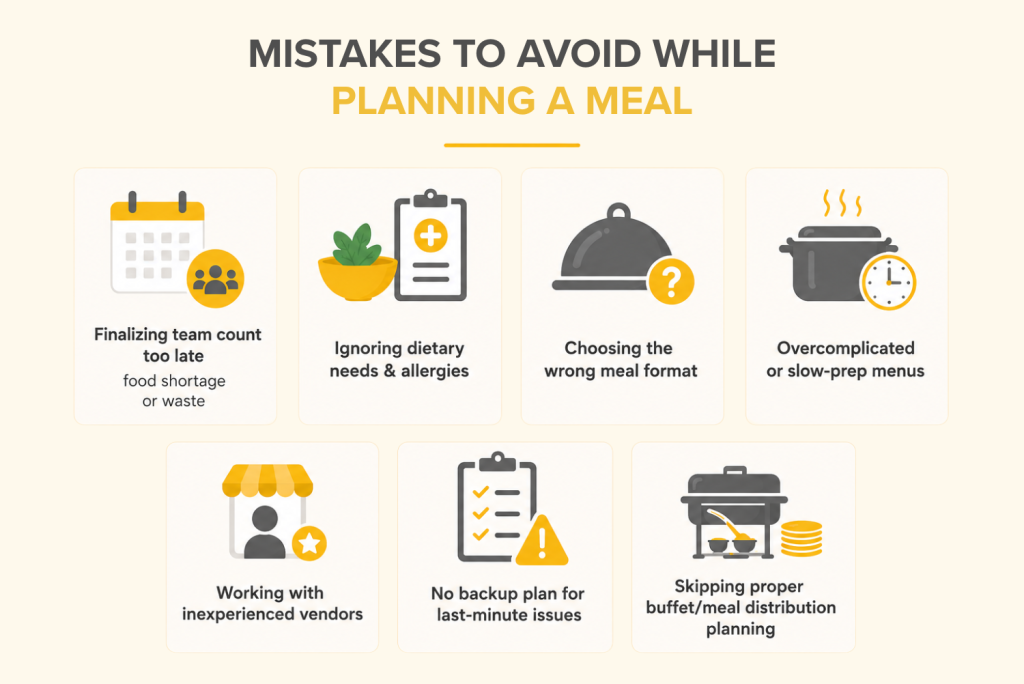
Giving attention to small details is also very important. Whether it’s a small team lunch or a large group meal planning, everything needs proper planning so that you can avoid all the mistakes that can make your team lunch experience worse. Here are some of the mistakes that should be avoided.
- Finalizing the team count too late, which leads to food shortage and wastage.
- Ignoring dietary needs and preferences, like allergies, can cause trouble.
- By choosing the wrong lunch format, which can cause chaos in team lunch.
- Choosing a menu with fancy dishes that take time for preparation and serving.
- Choosing a new or less experienced vendor complicates everything.
- Keeping no backup plans for the end to fix the problems on the spot.
- Skipping the buffet plan, which creates uncoordination while distributing meals.
8. Professional Catering for Large Groups
It is the situation when your team size increases beyond a manageable situation, and you now need professional catering for a large group. It has become a necessity instead of being a luxury, as serving everyone equally is significant. Experienced caterers understand your team lunches from the bottom up, i.e., from portion sizes to managing every employee’s likes and dislikes. They not only reduce the burden of HR teams and office administrators who are ordering food. With the right catering partner, team lunches become easy, predictable, and enjoyable.
Small Ideas That Make Team Lunches Memorable
- Team photo wall
- Conversational card game
- Truth or dare
- Guess the dish or ingredient
- Mini food polls
- Music and eating
- This or that (Food edition)
- Food rating cards
- Emoji voting
- Food memory game
- DIY food bars
- Blind taste tests
- Food trucks
- Guest musicians
Why Choose Nüu Catering for Large Group Meal Planning?
Large group meal planning comes with endless chaos, never-ending pressure, and fears relating to portion sizes. Catering for 10-200 people, corporate event catering, individual office meals, etc.—everything is managed by Nüu Catering very efficiently. We handle office meals for growing teams with accurate portion sizes and curated menus. If you want team lunches that run on time, avoid food shortages, and end complaints, we are the best choice to prefer. Plan your next team lunch with Nüu Catering and make large group meals feel effortless.
Where Food, Teams, and Timings Align
The best team lunches do not need complicated and large team meal planning; they need the right catering for large groups. When employees’ choices are prioritized, portions are accurate, the menu is balanced, the cutlery is the best, and logistics are handled smoothly, everything comes together to make team lunches successful. When food, teams, and timings come together, and team lunch becomes effortless and manageable.
Choose Nüu Catering for your next team lunch and let everything fall into place, on time, on point, and in a stress-free manner.
FAQs on How to Plan a Team Lunch for 20–200 People (Complete Guide)
1. How much food is required for 100 people?
A general rule is that to plan a team lunch for 100 people, there must be about 450 to 680 grams of total food per person, including main courses, sides, and desserts. This means 45 to 68 kg of total food.
2. What are some good lunch ideas for work in 2026?
Customized bowls and Korean food have become the trend nowadays. Grain bowls, sushi bowls, bento boxes, wraps & sandwiches, salads, healthy diet foods, etc.
3. Why is professional catering better than ordering food individually?
Professional catering is always better because they take care of everything, i.e., from how much to cook to serving smoothly. It is all dealt with by the professional caterers very well. Individual food orders only create chaos and confusion.
4. What are the fun activities for the team lunch ideas?
Some of the fun activities are themed cuisines, cooking challenges, bingo, board games, icebreakers, trivia, etc.