
AI Summary
Table of Contents:
Introduction
What Does It Mean for a Toronto Caterer to Be “Certified”?
How to Vet a Catering Company in Toronto: 10 Things to Check Before You Book
Know What Licenses Toronto Caterers Need Before You Book
Learn What Food-Handler Certification Covers
Know How to Verify Insurance and References
What to Ask Before You Approve a Vendor
Check How the Caterer Handles Dietary and Allergy Requirements
Test the Caterer’s Delivery and Event Logistics
Compare Pricing, Policies and What Is Actually Included
Use a Toronto Caterer Scorecard Before You Book
Know the Red Flags Before Signing a Catering Contract
The 10-Minute Toronto Catering Vetting Checklist
How Nüu Catering Simplifies Corporate Food Delivery in Toronto
Final Verdict
Frequently Asked Questions
| Key Takeaways Check applicable licenses, food-handler certification, inspection information and insurance before booking a Toronto caterer.A reliable caterer should have clear processes for dietary needs, allergies, delivery timing and last-minute changes.Review delivery, setup, taxes, minimums, cancellation terms and other charges instead of comparing food prices alone.Offices around Bay Street, Brookfield Place and the Financial District may require careful delivery coordination, especially during Toronto’s hot summer days.Rate each caterer on safety, compliance, references, dietary handling, delivery, pricing and support before making your final decision. |
It is 11:45 a.m. on a hot summer day. Your team is waiting for lunch at the meeting room, where the meeting is about to start in 15 minutes and the delivery has not arrived yet. This is when you realize that choosing a catering company is much more than finding food that looks good online.
For an office near Bay Street, a client meeting at Brookfield Place or a team lunch in the Toronto Financial District, food safety, delivery timing, dietary requests, communication and pricing can all affect the experience. So, how to vet a catering company in Toronto is a very important question.
It is best to start by looking beyond the menu. You also need to know what licences Toronto caterers need, what their food-handler training covers and how to verify insurance and references. That is what this guide will help you assess before you approve a Toronto catering vendor.
What Does It Mean for a Toronto Caterer to Be “Certified”?
The word “certified” can make you feel reassured about the quality of the food, but it does not tell you everything you need to know about a caterer. A certified Toronto caterer contains:
- A business license to legally prepare and sell food
- A DineSafe pass from Toronto Public Health
- Food-handler certification for staff
- Liability insurance in case something goes wrong
Each one covers a different risk. This means your vetting process should look at the business, its premises, its food handlers and its operating practices rather than relying on the word “certified” alone.
How to Vet a Catering Company in Toronto: 10 Things to Check Before You Book
Before signing a contract, check these ten areas:
- Food-premises compliance: Ask where the food is prepared and whether the premises meet applicable Toronto & Ontario requirements.
- Food-handler certification: Confirm that the business has properly trained food handlers.
- Inspection history: Check available Toronto Public Health inspection information where applicable.
- Business licensing: Ask which municipal licenses apply to the caterer’s specific operation.
- Insurance: Request current proof of appropriate commercial liability coverage.
- References: Ask for recent clients with events similar to yours.
- Dietary procedures: Find out how halal, vegan, gluten-free and allergy-related requirements are handled.
- Delivery controls: Ask how orders are scheduled, tracked and protected during transportation.
- Pricing: Get the full cost including delivery, setup, staffing, taxes, minimums and possible extra charges.
- Contract terms: Read cancellation, changes, refunds and late-delivery policies before approving the order.
A good caterer should be comfortable answering these questions. If basic information is difficult to obtain, then it is a clear sign that you should consider your decision once more.
Know What Licenses Toronto Caterers Need Before You Book
There is no single answer to “what licenses Toronto caterers need” because requirements can depend on how and where the business operates. Any business preparing food for sale in Toronto needs to operate from a licensed commercial kitchen.
Before booking, ask:
- Where is the food prepared?
- Is the preparation location a registered food premise?
- Has the appropriate public health authority inspected it?
- Does the business have the municipal approvals or licenses applicable to its operation?
- Can the company provide documentation if requested?
Do not assume that a caterer operating in Toronto follows exactly the same licensing process as every restaurant. The nature of the operation matters.
Learn What Food-Handler Certification Covers
Food-handler certification is more useful, as it covers the knowledge food handlers need to reduce food-safety risks while preparing, handling and serving food. It protects customers from health risks associated with food handling, preparation and cooking.
You can also ask how the team manages:
- Hand hygiene
- Safe food preparation
- Cross-contamination
- Temperature control
- Food storage
- Cleaning and sanitation
- Handling of potentially hazardous foods
For large corporate orders, these processes matter because a caterer prepares dozens or hundreds of meals at once. This matters even more in summer as Toronto’s summer hot days push up the risk of food sitting too long at unsafe temperatures especially for buffet-style corporate lunches sitting out in a boardroom.
| Want a shortcut? Nüu Catering only works with restaurant partners who already meet this standard |
Know How to Verify Insurance and References
Insurance protects your company, not just the caterer. If something goes wrong like an allergic reaction, a delivery accident or a health complaint, the caterer’s insurance is what responds rather than yours.
Your company also has its own minimum insurance requirements. So do not just ask, “Are you insured?” Ask for documentation because references matter too. Also request examples of recent corporate clients or events similar to yours. A useful reference should help you understand:
- Was the food delivered on time?
- Was communication easy?
- Were dietary requirements handled correctly?
- Was the invoice accurate?
- How did the caterer respond when something changed?
| Planning a corporate lunch in Toronto? Choose a catering partner that can explain its process before you place the order. |
What to Ask Before You Approve a Vendor
Do not wait until the contract stage to ask important questions. A short vendor call can reveal a lot. These are the important questions that you need to ask:
Who will be responsible for my order?
You want to know whether there is a dedicated contact or support team.
What happens if the headcount changes?
This matters when meetings move or employees join at the last minute.
How do you handle a late delivery?
A good answer should explain the process rather than promising that delays will never happen.
What is included in the quoted price?
Ask about delivery, setup, utensils, serving equipment, taxes and other charges.
How are dietary requirements labelled?
The answer should be specific rather than we can accommodate them.
You can also ask these questions like
- Which kitchen does the food come from?
- What’s your current DineSafe status?
- Are staff food handlers certified?
- Can you send a certificate of insurance?
- How do you label allergens?
- What happens if delivery is late?
- Can I speak to two current clients?
Check How the Caterer Handles Dietary and Allergy Requirements
Toronto offices are diverse. A corporate menu needs to work for more than one person. One employee needs a halal meal, another may be vegan and someone else may need gluten-free food.
A good caterer labels every item clearly on the box or platter. For example, Nüu Catering provides group orders that can arrive in one combined delivery with individual labels and dietary tags. Its Toronto corporate catering offering includes halal, vegan, gluten-free and kosher-style options.
Test the Caterer’s Delivery and Event Logistics
A caterer can have excellent food and still be difficult to work with. Toronto offices create their own logistical challenges. Think about a meeting at Brookfield Place, near Bay Street or a team lunch where employees have only a short break. Ask how the caterer manages:
- Delivery windows
- Building access
- Loading areas
- Elevators
- Large orders
- Individual meal labels
- Temperature-sensitive food
- Last-minute changes
- Delivery tracking
Toronto’s hot summer days make temperature control and delivery timing especially important for foods that require careful handling. If possible, start with a smaller order before committing to a major corporate event. It gives you a real test of the caterer’s communication, packaging, timing and food quality.
Compare Pricing, Policies and What Is Actually Included
Cheapest is not always safest. A price below every other quote means something is missing such as insurance, certified staff or proper packaging. Compare the complete price.
Look at:
- Food cost
- Delivery
- Setup
- Staffing
- Equipment
- Taxes
- Minimum order
- Rush charges
- Cancellation fees
- Changes to guest numbers
Also check whether the caterer provides one invoice or leaves your team managing multiple vendors.
Use a Toronto Caterer Scorecard Before You Book
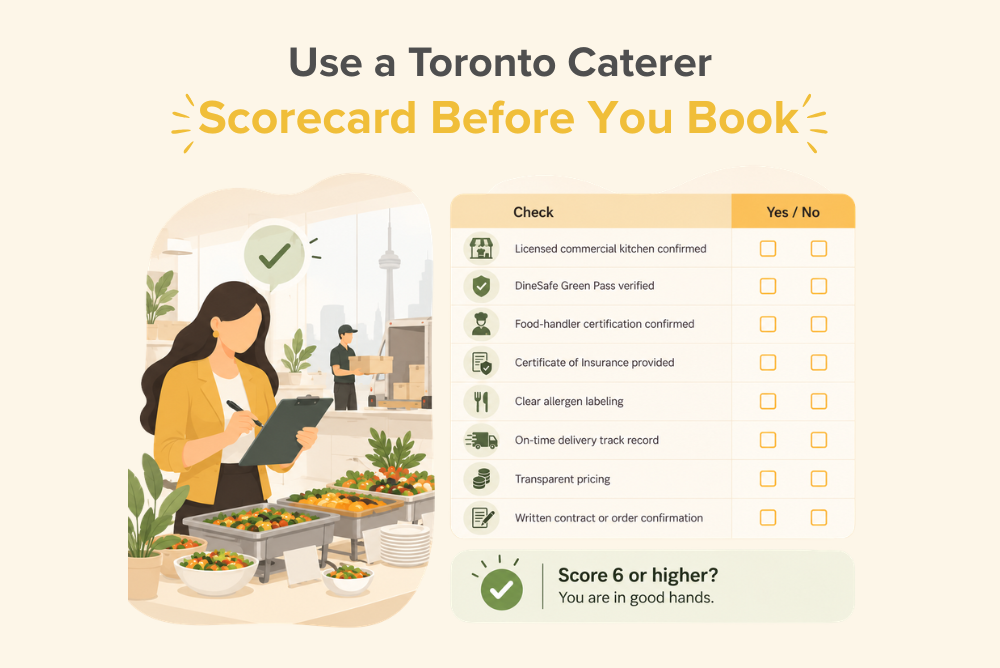
Here is a simple scorecard. Give one point for each “yes.”
| Check | Yes / No |
| Licensed commercial kitchen confirmed | |
| DineSafe Green Pass verified | |
| Food-handler certification confirmed | |
| Certificate of Insurance provided | |
| Clear allergen labeling | |
| On-time delivery track record | |
| Transparent pricing | |
| Written contract or order confirmation |
Score 6 or higher? You are in good hands.
Know the Red Flags Before Signing a Catering Contract
Be cautious if a caterer:
- Cannot clearly explain where food is prepared.
- Avoids questions about food-handler certification.
- Will not provide basic insurance documentation.
- Has no relevant corporate references.
- Gives vague answers about allergies.
- Cannot explain its delivery process.
- Provides a quote with unexplained charges.
- Pressures you to sign before reviewing the terms.
- Makes promises that are not included in the contract.
- Has no clear process for handling delivery problems.
The 10-Minute Toronto Catering Vetting Checklist
Before you book, spend ten minutes checking:
Minute 1–2: Find out where the food is prepared.
Minute 3: Check food-handler certification requirements.
Minute 4: Review available inspection information.
Minute 5: Ask about applicable licenses.
Minute 6: Request proof of insurance.
Minute 7: Ask for a relevant corporate reference.
Minute 8: Confirm dietary along with allergy procedures.
Minute 9: Confirm delivery as well as late-order procedures.
Minute 10: Review the complete quote and contract.
If the caterer can answer these questions clearly, you have a much stronger basis for approving the vendor.
How Nüu Catering Simplifies Corporate Food Delivery in Toronto
Vetting a catering company is not only about checking documents. You need a partner that can make the whole ordering process easier for your team.
Nüu Catering is built around corporate food delivery for Toronto workplaces with more than 35 curated restaurant partners like Pumpernickels and What-A-Bagel along with restaurants such as Imperfect Fresh Eats, Azul, Mevame, Lambretta Pizzeria and Café Landwer.
We provide food deliveries in areas including Downtown Toronto, the Financial District, Liberty Village, North York, Scarborough and Etobicoke.
Final Verdict
Knowing how to vet a catering company in Toronto helps you look beyond attractive menus and online reviews. Check food-premise compliance, food-handler certification, licenses, insurance and references before you book. For corporate teams, the best catering partner should make these details easier to manage. Whether your office is near Bay Street, Brookfield Place or another Toronto business hub, choose a caterer that can support both the food and the logistics behind it.
Planning your next Toronto office meal?
Explore Nüu Catering to see how group ordering and coordinated delivery can simplify the process.
Frequently Asked Questions
Q. Which food safety certification is best in 2026?
Look for food-handler training recognized by Ontario rather than relying on a generic “food safety certified” claim. Ontario recognizes approved food-handler training programs that meet provincial requirements.
Q. How to get a food safety certificate in Canada?
Requirements vary by province. In Ontario, food handlers can complete training through a local public health unit or an approved commercial provider recognized by the Ministry of Health.
Q. How early should I vet a catering company for a corporate event?
For a small meeting, start at least a few weeks ahead. For large corporate events, recurring meals or events with complex dietary as well as delivery requirements, start earlier so that you can get time to verify the vendor along with testing the service.