
AI Summary
Table of Contents:
Introduction
Small vs. Large Catering Companies: What Actually Changes?
Small vs. Large Catering Company in Toronto: 7 Factors to Compare
Small vs. Large Catering Companies in Toronto
Why This Decision Is Harder Than It Looks
What “The Best of Both” Actually Looks Like
How to Choose the Right Catering Company for Your Toronto Office
Which Caterer Is Right for You?
Why Nüu Catering Is Different From a Traditional Caterer
Summing Up
Frequently Asked Questions
| Key Takeaways Small caterers can offer more flexibility and personalized service.Large caterers are often better equipped for high-volume office events.Price alone is not enough. Compare delivery, staffing, dietary handling and coordination.The right catering model should match your office size, event type and employees’ meal preferences. |
What would you pick for your next office lunch: a small caterer or a large catering company?
Before you answer, think about what you really need.
- Is it the lowest price?
- Better menu variety?
- More personalized service?
- Reliable delivery to your Bay Street office?
- Catering partner that can handle 30 meals today and 200 later?
This is where the comparison between small vs. large catering companies in Toronto gets interesting. It is easy to assume that a large provider will be more reliable and a smaller one will offer better service. But in your office the whole situation is different.
You might be planning a 20-person team lunch one week and a 150-person event the next week. You need individual meals, dietary options and delivery to a busy Toronto Financial District office. That is how company size affects reliability and price when you observe closely.
In this blog, let us compare both the options based on the things that can make or break an office catering experience.
Small vs. Large Catering Companies: What Actually Changes?
The size of a catering company can affect how it handles your order. It is not just about how much food a company can make. It is about how fast they respond, how flexible they are and how they handle a last-minute change or a dietary request.
A small or boutique caterer may be able to respond quickly to a custom request. You can also deal directly with the same person throughout the process. A large caterer has more staff and production capacity, which is useful when you are managing a conference, large corporate event or recurring meal program.
Small vs. Large Catering Company in Toronto: 7 Factors to Compare
Here are the 7 factors that truly matter when you compare catering companies in Toronto for your office.
1. How Company Size Affects Reliability and Price
One of the biggest mistakes is comparing caterers only by the price per meal. A lower menu price may not mean a lower final cost.
Smaller caterers may have more flexibility when creating a menu or quote for a specific event. Their capacity is more limited during busy periods. Large caterers have organized systems for handling higher volumes. They also have more staff and resources for large events. That does not mean they will always cost more.
A catering partner that combines different restaurant choices into one organized order can also change how you think about cost. Nüu Catering allows employees to select meals from a curated menu while the orders are combined into one delivery and invoice.
2. Menu Flexibility and Customization
Menu flexibility matters more in an office than it does for a simple private lunch. Imagine ordering food for 50 employees. You do not want everyone to receive the same meal just because it is easier for the caterer.
As one employee prefers a Mediterranean bowl from Café Landwer, another wants something from Naan Kabob and someone else prefers a lighter meal from Mad Radish.
Having variety can make group ordering easier because employees have some control over what they eat. Smaller caterers are perfect when you need a very specific custom menu, whereas large caterers can be useful when you need a broad menu and standardized service.
The better choice depends on whether your priority is customization, variety or operational simplicity.
3. Delivery Reliability for Toronto Offices
Food arriving late is more than an inconvenience. It can interrupt a meeting, leave employees waiting and create unnecessary work for the one who placed the order.
This becomes important in Toronto’s busy business areas. A lunch going to an office near Bay Street may have different delivery considerations from one going to an office in North York or Etobicoke.
When comparing caterers, ask:
- How are delivery times scheduled?
- Can you provide detailed building instructions?
- Who handles delivery issues?
- What happens if an item is unavailable?
- Can recurring orders be scheduled?
- Is there a way to know when the order is on its way?
This is where a coordinated catering platform can be useful. Nüu Catering ordering together model combines individual employee selections into one delivery with individual labels and dietary tags.
4. Dietary Requirements and Individual Meal Choices
Every office has different needs. Dietary planning is one of the easiest parts of office catering to underestimate. You are not ordering 50 lunches; you may be ordering:
- 30 standard meals
- 6 vegetarian meals
- 5 vegan meals
- 4 halal meals
- 3 gluten-free meals
- Plus individual allergy notes
A good catering process should make these choices easy to identify. Labelling matters too. When individual meals are clearly marked, employees do not have to open several boxes to find the meal that works for them. This is particularly helpful for larger team lunches where food is being served at the same time.
5. What Large Caterers Offer
Large catering companies have some clear advantages. Their size can give them more production capacity and staff for high-volume events. They may also have established systems for:
- Large guest counts
- Event staffing
- Setup and breakdown
- Recurring corporate orders
- Standardized menus
- Large-scale production
- Complex event schedules
This can make a large caterer a strong choice for a 200-person conference or a major corporate event.
6. When a Boutique Caterer Beats a Large One
There are situations where smaller is better. A boutique caterer is the right choice when you are planning a smaller event and want close communication throughout the process. For example, a leadership team of 15 wants a highly customized lunch for a private meeting.
A smaller provider may also make sense when:
- You have a very specific menu.
- You want direct communication.
- You need a custom event setup.
- The guest count is relatively small.
- Personal service is a priority.
Gist: The goal is not to find the smallest or largest provider; it is to find the right operating model for your office.
7. Scalability: From 20-Person Lunches to Large Office Events
This is where most companies actually get stuck. Office catering needs can change quickly. One week you may need breakfast for 20 people; the next week your company may have a 100-person training session. Then comes a 200-person all-hands meeting.
This is why scalability matters.
Nüu’s corporate catering model is designed around office groups ranging from smaller team meals to larger corporate orders. They provide a network of restaurant partners, giving offices access to different cuisines instead of relying on one fixed menu.
Small vs. Large Catering Companies in Toronto
| Factors | Small Catering Companies | Large Catering Companies |
| Personal service | It is best for small catering. | It is more organized. |
| Custom menus | They provide flexible menus. | They usually follow set menus. |
| Menu variety | It depends on the caterer. | They offer a wider range. |
| Last-minute changes | Here it is easier to make changes. | Here you need to follow a certain process. |
| Event staffing | It depends on the provider. | You have a larger team to coordinate. |
| Best Suited For | Small teams, private lunches and customized events | Large office events, conferences and high-volume orders |
| Scaling between events | It depends on availability capacity. | It is easier for large team events. |
| Recurring office lunches | These are good if the caterer has enough capacity. | This suits structured recurring programs. |
Key Note: Company size is only one part of the decision. For office catering, compare capacity, flexibility, delivery, dietary handling and the amount of coordination your team will need to manage.
Why This Decision Is Harder Than It Looks
You might think choosing a caterer is simply about finding good food at a reasonable price. For an office, there is more than that. It is not only ordering food; it includes the whole planning.
The temperature is rising, employees are moving between meetings and the lunch window is short. Someone needs a vegan meal, another person cannot have gluten and your delivery is going to a busy downtown building.
It is all about timing, a reliable catering partner and how much work the catering company takes off your plate. The best catering partner should make office lunch easier to manage, not give your team another project.
What “The Best of Both” Actually Looks Like
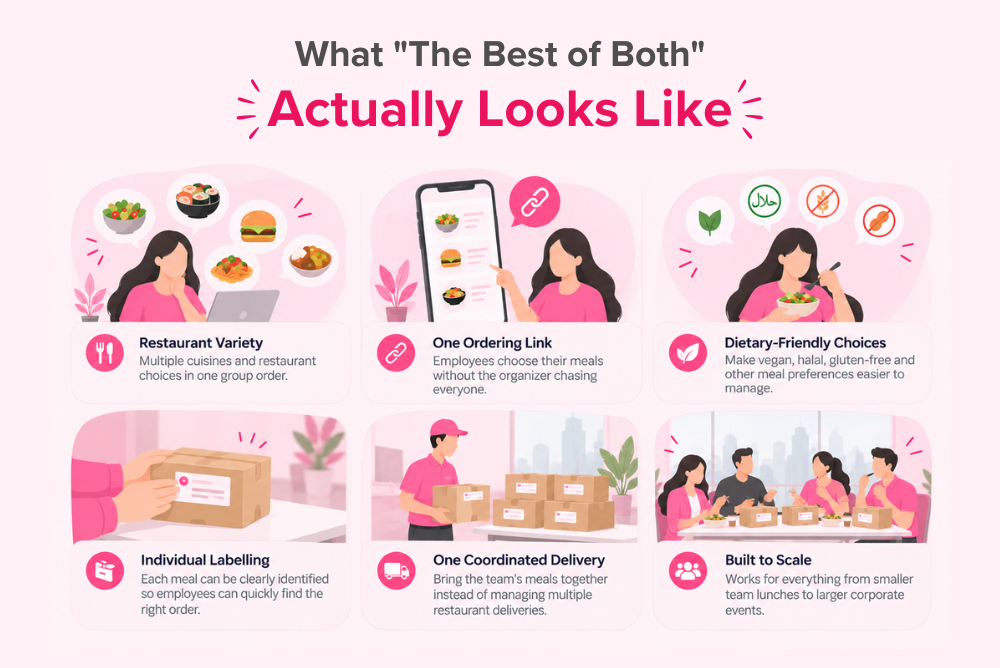
One office order. More choice. Less coordination.
Restaurant Variety
Multiple cuisines and restaurant choices in one group order.
One Ordering Link
Employees choose their meals without the organizer chasing everyone.
Dietary-Friendly Choices
Make vegan, halal, gluten-free and other meal preferences easier to manage.
Individual Labelling
Each meal can be clearly identified so employees can quickly find the right order.
One Coordinated Delivery
Bring the team’s meals together instead of managing multiple restaurant deliveries.
Built to Scale
Works for everything from smaller team lunches to larger corporate events.
How to Choose the Right Catering Company for Your Toronto Office
Before you choose a provider, forget about whether it is small or large for a moment. Start with these important points, which you need to keep in mind.
1. Consider your headcount
How many people will eat? A 15-person meeting and a 200-person event require different levels of capacity.
2. Think about employee choice
Will one menu work for everyone? If there is no fixed menu, then look for a catering model that allows individual meal selection.
3. Check dietary handling
Do not just ask whether dietary options are available. Ask how they are ordered, prepared, labelled and delivered.
4. Consider your location
A catering company serving an office near the Toronto Financial District needs to understand delivery timing and building logistics. The same applies to offices in Liberty Village, North York, Scarborough or Etobicoke.
5. Look at the ordering process
How much work will your team have to do? If the organizer has to collect every meal choice manually, follow up on dietary requests and coordinate several deliveries, the process can become unnecessarily complicated.
6. Think beyond one event
If your company orders food regularly, choose a provider that can support different event sizes and recurring needs.
| Looking for a simpler way to manage office meals? Nüu Catering brings restaurant variety and coordinated group ordering together for Toronto teams. |
Which Caterer Is Right for You?
Choose a small or boutique caterer if:
- You need a highly customized menu.
- Your event is relatively small.
- Direct communication is important.
- Personal service is a priority.
Choose a large caterer if:
- You are managing a high-volume event.
- You need significant production capacity.
- You require event staffing.
- Standardized execution works for your event.
Consider an office-focused catering platform if:
- Employees want different meals.
- You want multiple restaurant options.
- You need one coordinated delivery.
- You manage recurring office meals.
- Dietary labeling matters.
- Your team size changes between events.
Why Nüu Catering Is Different From a Traditional Caterer
Nüu Catering takes a different approach to office food. Instead of asking the whole team to choose from one restaurant menu, we let employees select their own meals from a curated network of restaurant partners.
One person starts the group order and shares the link. Employees make their selections and the meals are then brought together into one coordinated office delivery with individual labels and dietary tags.
This gives Toronto offices more variety without requiring the organizer to place and track multiple restaurant orders. We also serve areas across Toronto and the GTA including Downtown Toronto, the Financial District, Liberty Village, North York, Scarborough and Etobicoke.
Summing Up
In the end, choosing between small vs. large catering companies in Toronto has no universal answer. A boutique caterer can be ideal when you want personal service and a customized menu. A large caterer can be the better choice when you need high capacity, staffing and established event systems. Therefore, the best choice is not about finding the biggest caterer; it is about finding the catering model that works for your people, your office and your next event.
Planning your next team lunch or corporate event?
Try Nüu Catering for a more flexible way to feed your office.
Frequently Asked Questions
1. What type of catering is most profitable in 2026?
Corporate catering can be a strong business model because offices may need recurring lunches, meetings, training days and larger events. Profitability depends on food costs, labour, delivery, order volume and operating efficiency.
2. How can I compare catering companies for an office event in 2026?
Compare the complete service, not just the meal price. Look at delivery, menu flexibility, dietary handling, capacity, minimum orders, customer support and any additional fees.
3. What do large caterers offer that small caterers may not?
Large caterers have greater production capacity, more event staff and established systems for handling high-volume or complex events. The exact services vary between providers.