

AI Summary
Table of Contents:
Introduction
What Is a Corporate Food Delivery Tax Deduction in Canada?
9 Types of Corporate Food Delivery Expenses and Their Tax Treatment
What CRA Rules Apply To Employer-Provided Meals
How to Expense Food Delivery for Your Business
What Is Deductible for Corporate Food Programs?
8 Ways to Maximize Legitimate Tax Deductions
Simplify Your Corporate Food Delivery Program with Nüu Catering
Wrapping Up
Frequently Asked Questions
Every Friday, offices across Toronto come with team lunches. From meetings at Brookfield Place to client discussions on Bay Street, corporate food delivery keeps employees productive mainly during Toronto’s hot summer days.
While ordering meals is simple, understanding the corporate food delivery tax deduction in Canada’s CRA rules is a bit complicated. Many businesses think:
- What CRA rules apply to employer-provided meals
- How to expense food delivery correctly
- What is deductible for corporate food programs
This blog breaks down the CRA guidelines in simple language that help you manage workplace meal expenses with confidence while keeping your team satisfied.
What Is a Corporate Food Delivery Tax Deduction in Canada?
A corporate food delivery tax deduction means that businesses may be able to claim some food delivery expenses when filing their taxes. To claim those, the meals must be ordered for a business reason and must follow CRA guidelines.
Example: If you order lunch for an employee training session, a client meeting or a board meeting, it will qualify as a business expense. But ordering food for personal reasons is not covered under it.
The Canada Revenue Agency (CRA) checks why the meal was ordered, who received it and whether the business has kept proper receipts & records. There are a few exceptions like certain staff parties, which can be 100% deductible if specific conditions are met.
If you know the category of your order, then you can save your food expenses properly.
9 Types of Corporate Food Delivery Expenses and Their Tax Treatment
Not every meal is treated the same way by CRA. Different workplace situations have different tax expenses. Below are some of the most common types businesses face.
1. Team Lunch Deliveries
Regular team lunches help employees build stronger workplace relationships. Many Toronto businesses schedule team lunches after project milestones or monthly meetings.
Regular team lunches during work hours are 50% deductible as a meal and entertainment expense. Ordering from financial district favorites like Café Landwer or Freshii for a Bay Street team meeting will still fall under this rule.
| Planning regular employee lunches? Nüu Catering makes it easy to organize recurring office meal programs with a wide selection of trusted restaurant partners. |
2. Client Meeting Catering
Meals shared with clients while discussing business are also subject to the 50% limit. Whether you are presenting a proposal on Bay Street or hosting a networking office lunch in Downtown Toronto, catering can covert it into a professional team lunch.
Businesses should clearly document:
- Business purpose
- Client names
- Meeting date
- Restaurant invoice
3. Employee Training Meals
Food provided during in-house training sessions is treated as a business expense that also comes under the 50% rule. As team lunches only help employees stay focused without leaving the workplace.
Whether it is onboarding new hires or professional development workshops, these meals are easier to show claims when they are directly connected to business activities in the whole sense.
4. Recruitment Interview Meals
Lunches during interviews count as a business meal expense that also comes under 50% deductibility. Offering lunch to candidates during multiple interview rounds creates a positive experience as conversations take place naturally.
Businesses should keep these meals under record with proper documentation that makes future reporting much easier. They can keep records like
- Candidate name
- Interview purpose
- Date
- Receipt
5. Board Meeting Catering
Board meetings are mainly several hours long. Providing breakfast or lunch helps meetings run efficiently without any chaos from deciding what to eat. Companies can order individually packaged meals or shared catering depending on team size. Keeping the meeting agenda together with the invoice provides useful supporting documentation.
6. Holiday Celebrations
Seasonal parties such as summer or year-end celebrations can qualify for a deduction if the event is open to all employees. It happens many times in a year. Therefore, holiday lunches are a popular way to thank employees for their hard work.
These events should be organized as a company function with proper planning rather than any random personal gatherings. Attendance records and invoices help in maintaining accurate expense files.
7. Employee Appreciation Lunches
Recognizing employee achievements improves morale as well as the productivity of the employees. A catered lunch after completing a major project or reaching quarterly goals can be a meaningful way to celebrate your success.
Thus, companies can rotate cuisines to keep meals interesting by choosing options from trusted local restaurant partners available through Nüu Catering. These events should be properly documented as part of employee recognition programs to get claims.
8. Remote Employee Meal Reimbursements
Hybrid and remote work have changed the whole scenario of corporate catering. Instead of gathering everyone in one office, some companies send lunches to employees that they enjoy during virtual workshops, online training sessions or company-wide meetings. Having a clear reimbursement policy maintains consistency across teams.
9. Hybrid Team Lunch Programs
Many organizations now operate with employees working both from home and the office. Some businesses schedule monthly in-office lunch days to encourage collaboration. Others arrange coordinated deliveries for employees attending important virtual events. Having a written meal policy helps businesses manage these programs more effectively.
What CRA Rules Apply To Employer-Provided Meals
Understanding what CRA rules apply to employer-provided meals helps businesses manage food expenses more effectively.
1. Meals Provided for Business Purposes
Meals provided during business activities are deductible when properly documented.
- Training sessions
- Client meetings
- Interviews
- Board meetings
- Keep receipts and record the business purpose
2. Meals That May Be Considered Taxable Benefits
Some meals can be treated as taxable depending on their purpose.
- Provided regularly for personal convenience
- No clear business purpose
- May be taxable under CRA rules
- A company meal policy helps avoid confusion
3. Employee Appreciation and Social Events
Meals for employee appreciation and social events help improve workplace morale.
- Employee appreciation events
- Team celebrations
- Boost workplace morale
- Save invoices and record event details
4. Client Meals vs Employee Meals
It is important to distinguish between client meals and employee meals for proper tax treatment.
- Client meals support business discussions
- Employee meals linked to training or team collaboration
- Keep expenses separate
- Document the purpose of each meal
How to Expense Food Delivery for Your Business
Many businesses ask how to expense food delivery correctly. The process becomes much easier when you follow these seven steps.
Step 1: Create a company meal policy
Start with a written meal policy. Your policy should explain:
- When meals can be ordered
- Spending limits
- Approval process
- Eligible occasions
- Reimbursement rules
Step 2: Use centralized ordering
Ordering through one platform makes managing expenses much easier. This offers several benefits:
- Easier invoice tracking
- Better budget control
- Consistent ordering
- Simplified reporting
- Fewer administrative tasks
Step 3: Collect digital receipts
Every food order should include a digital receipt. Businesses should save:
- Restaurant invoice
- Payment confirmation
- Delivery receipt
- Order summary
Step 4: Record attendees
Always keep a record of your attendees. This information adds content to the expense. Your records may include:
- Employee names
- Client names
- Department
- Meeting organizer
Step 5: State the business purpose
One of the most important parts of expense management is explaining why the meal was purchased. For example:
- Quarterly marketing strategy meeting
- New client presentation
- Employee onboarding session
- Leadership planning workshop
- Recruitment interview
Step 6: Submit expenses promptly
When you wait too long to submit meal expenses that leads to missing receipts plus forgotten details. By submitting expenses properly it can:
- Reduce errors
- Improve bookkeeping
- Speed up reimbursements
- Keep monthly reports accurate
Step 7: Store records securely
Once expenses are approved, keep all supporting documents together. These are the following things that you need to store.
- Receipts
- Invoices
- Approval emails
- Meeting agendas
- Attendance records
What Is Deductible for Corporate Food Programs?
When businesses ask what is deductible for corporate food programs, it depends on why the meals were provided. As most day-to-day office meals fall under the 50% deduction rule, fully deductible categories are limited to company-wide social events that are held a few times a year.
Common examples include:
- Employee training and workshops
- Client meetings
- Board meetings
- Recruitment interviews
- Team meetings with a business purpose
- Company social events that meet CRA guidelines
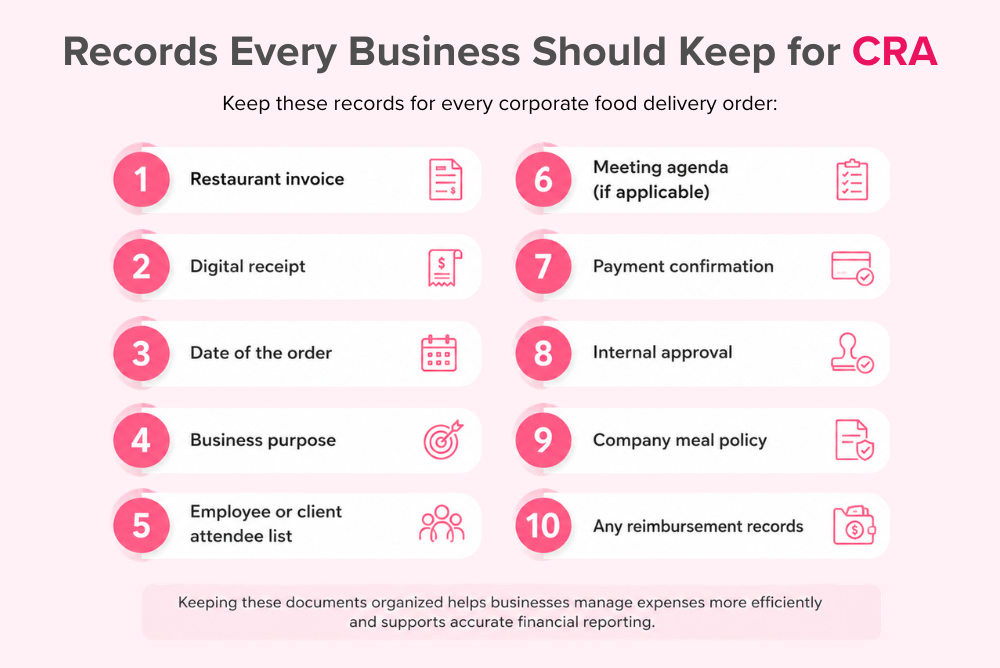
Keep invoices, receipts and a note that explains the business purpose for every meal expense. By keeping records you can manage corporate food delivery expenses much more easily.
| Want a meal program that keeps your receipts and records organized automatically? See how Nüu Catering can help. |
8 Ways to Maximize Legitimate Tax Deductions
By following a few simple practices you can manage meal expenses more efficiently while maximizing legitimate tax deductions. Here are some tips to keep your corporate food delivery records organized.
- Create a clear company meal policy for consistent expense reporting.
- Use one corporate ordering platform to simplify billing as well as invoicing.
- Keep digital receipts for every food delivery order.
- Separate client meals from employee meals for accurate bookkeeping.
- Record the business purpose for each meal expense.
- Review meal expenses regularly to identify errors or duplicate claims.
- Train managers on your company’s meal expense policy.
- Partner with a reliable corporate food delivery provider to streamline expense management.
Simplify Your Corporate Food Delivery Program with Nüu Catering
Running a business in the Toronto Financial District means juggling a lot with other matters and on top of it corporate food delivery adds stress with the hectic work schedule. Then Nüu Catering brings centralized ordering and a wide mix of restaurant partners across the city.
We help companies across Toronto, North York, Etobicoke, Mississauga, Scarborough and the Greater Toronto Area to streamline corporate food delivery through one easy-to-manage platform.
From a Café Landwer breakfast spread to a Freshii bowl bar or a What-A-Bagel morning platter, every order comes with a clean receipt. Even our centralized ordering, recurring scheduling and consolidated billing also make workplace meal management much easier for HR and operations teams.
Wrapping Up
A well-planned corporate food delivery program can support your business beyond providing convenient meals. With clear policies, proper documentation and an understanding of CRA guidelines, managing workplace food expenses becomes much more straightforward. Whether it is client lunches, team training or regular office catering, staying organized makes all the difference.
Ready to simplify your workplace meal program?
Explore Nüu Catering‘s corporate food delivery solutions and discover how easy office catering can be across Toronto and the GTA.
Frequently Asked Questions
Q1. Do recurring office lunch programs qualify for deductions?
Recurring office lunch programs qualify as business expenses when they are served for a business purpose. Businesses should maintain invoices, attendance records and a written meal policy.
Q2. What documents does CRA require for meal expenses?
Businesses should keep:
- Restaurant invoices
- Digital receipts
- Payment confirmations
- Attendee lists
- Meeting details
- Approval records
- Notes explaining the business purpose
Q3. Can hybrid workplace lunches be claimed as a business expense in 2026?
Hybrid workplace lunches are treated as business expenses that depend on the purpose of the meal and how the program is structured. By following CRA guidance, businesses can manage these expenses appropriately.